Currently Empty: $0.00

Dr. Arti Verma
- December 9, 2025
- Comment 0
Year 5 NAPLAN reading and numeracy
Checklist for busy parents
Introduction
You want your Year 5 child to feel ready for NAPLAN preparation without turning your home into a classroom. You also have a full life that does not leave space for long study marathons. The good news is that year 5 readiness grows best through short habits that fit into daily life. When you blend reading and numeracy into ordinary routines, your child strengthens skills steadily and stays calm. This guide gives you a clear checklist that focuses only on reading and numeracy for Year 5. Every item is practical and short. Everything is written for Western Australia parents who want results without stress.
The goal is simple. Help your child read with understanding and reason with numbers in a way that feels natural. You will find a concise plan you can follow during busy weekdays and flexible weekends. You will also see how to use practice sparingly and how to keep motivation high. Keep this checklist open on your phone or print it and place it where you can glance at it during the week. Consistency matters more than volume. A few minutes a day can change the entire experience for your child.

How to use this checklist
Use this checklist as a menu rather than a script. Choose a small number of items from the reading list and a small number from the numeracy list each day. Rotate items through the week so your child sees variety. Keep sessions short. Five to fifteen minutes is enough for most activities. If an item feels heavy today, swap it for a lighter one and return to it later in the week. The aim is steady exposure without pressure.
Talk during and after each activity. Conversation is not an extra step. It is the step that turns effort into deeper understanding. Ask your child what they noticed, what confused them and what they enjoyed. Your calm interest builds confidence and helps them process ideas more deeply. If an item becomes easy, celebrate progress and step up the challenge a little next time. If it is hard, break it into smaller parts and slow the pace. Your child will show you the right level through their energy and mood.
Reading checklist for busy families
Daily sustained reading
Ask your child to read for a short period every day. Ten to fifteen minutes is enough. Let them choose from novels, short factual pieces child child-friendly news or science explainers. Choice builds ownership and momentum.
Talk first, then read
Before they start reading, ask what they think the text might contain based on the title and opening lines. This tiny preview exercise warms up attention and improves comprehension during reading.
Pause and predict
Halfway through a page or section, ask what might happen next or what idea the writer is moving toward. Prediction turns passive reading into active thinking and trains your child to track meaning.
Retell in simple order
After reading, ask your child to tell you the main idea in plain words. Then ask for the most important detail that proves that idea. Clear retelling shows understanding and prepares your child for questions that ask for the main point and evidence.
Find the line that proves it
Choose a question about the text and ask your child to show the exact line that supports the answer. This habit builds evidence finding and prevents guesswork.
Compare two short texts
Once or twice a week read two short pieces on a related topic. Ask how the tone or purpose feels different. Ask which one gives clearer information and why. This develops comparison skills and critical reading.
Build meaning through vocabulary
When a new word appears, pause and discuss the meaning using nearby sentences. Ask your child to create a sentence with the word. Use the word later in a natural conversation. Repeated use turns new words into working vocabulary.
Notice how a paragraph is built
Pick one paragraph and ask your child to spot the sentence that introduces the idea. Ask what supporting details follow. This improves structure awareness and helps with reading long texts efficiently.
Skim then read deeply
Ask your child to skim a short factual page to spot headings and topic sentences. Then read one section slowly and retell it. Moving between overview and detail makes reading flexible and efficient.
Summarise with a title
After finishing a passage, ask your child to invent a short title that captures the main idea. If the title is already presen,t ask for an alternative that still fits. Title writing is a quick way to test comprehension and precision.
Read instructions with care
Find any short set of instructions for a simple task. Ask your child to read and explain the steps in order. Careful reading of instructions is a core skill that quietly supports success across all subjects.
Read a table or chart in words
Show a simple table or chart and ask your child to describe what it shows in one or two clear sentences. Translating visuals into words strengthens interpretation skills often used in assessments.
Take turns out loud
On some days, try shared reading aloud. You read a paragrap,h then your child reads the next. This supports fluency and confidence with unfamiliar words while keeping the mood warm and collaborative.
Choose a favourite line
Ask your child to pick one line they liked and explain why it stood out. This builds engagement and pushes them to think about tone, word choice, and meaning.
Numeracy checklist for busy families
Numbers in the kitchen
Invite your child to measure ingredients, read scales, estimate portions and adjust simple recipes. Ask how they would double a quantity or share it fairly. Real measures turn numbers into number sense.
Time sense through daily plans
Ask what time it is now and what time a task will start or end. Ask how many minutes remain before you leave the house. Small-time questions build strong number intuition.
Money talks in the shop
Discuss prices, discounts and change. Ask which deal is better and why. Encourage mental strategies rather than calculators for small sums. Every day costs make arithmetic feel purposeful.
Estimate before you calculate
Before solving a question, ask for a quick estimate. After solving, compare the exact answer to the estimate and discuss any gap. Estimation builds judgment and prevents careless errors.
Explain it out loud
When your child solves a problem, ask them to explain each step. If a step is unclear, ask what rule or idea they used. Saying the method aloud strengthens reasoning and memory.
Choose the strategy
Present one question and ask for two possible strategies. For example, an area problem might be solved by counting units or by multiplying side lengths. Choosing a method shows understanding beyond rote steps.
Decode word problems
Ask your child to underline the question part, identify known values and state what is missing. Then ask for a plan to solve. This routine reduces confusion and brings calm to mixed language and number tasks.
Patterns and rules
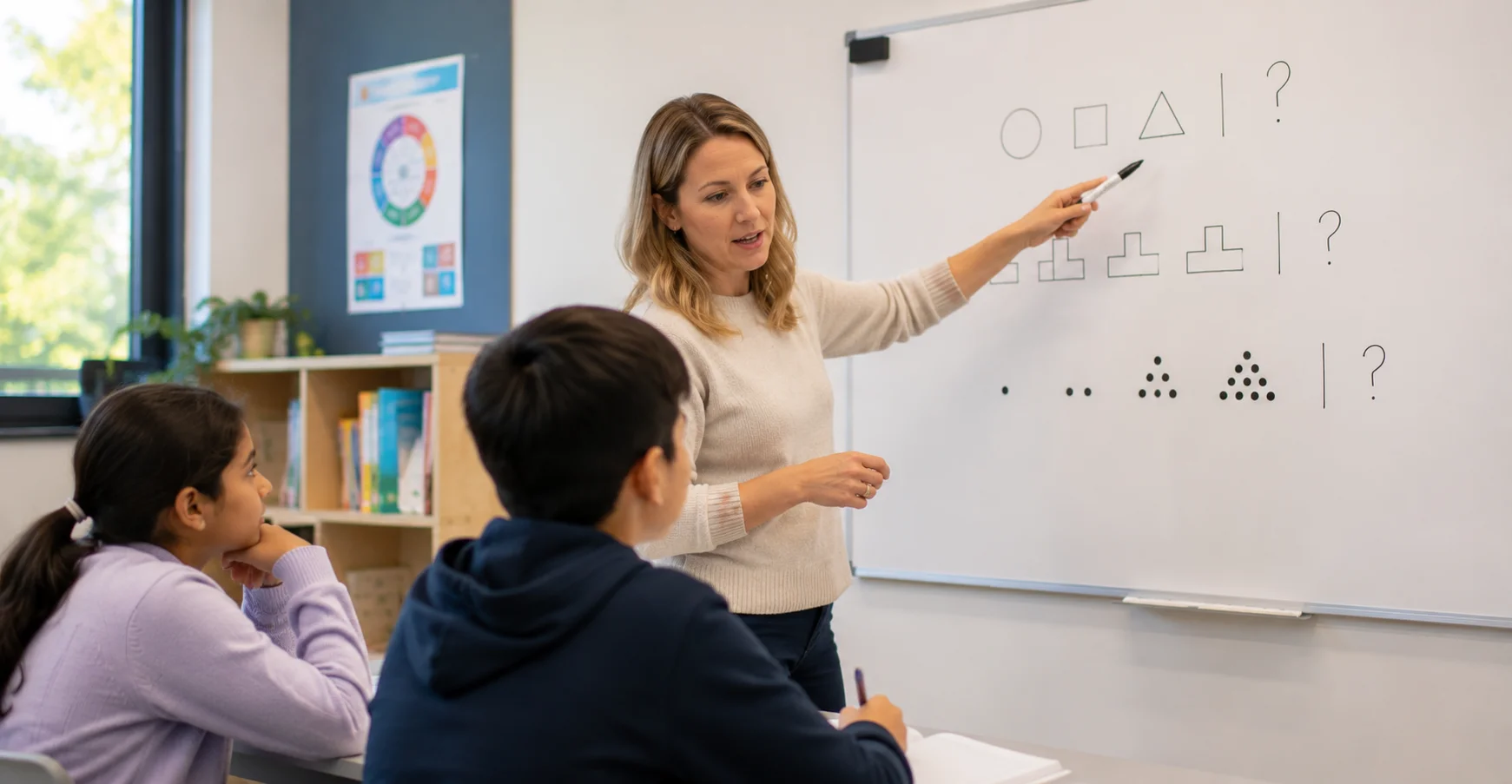
Create short patterns with numbers shapes or objects and ask your child to continue and describe the rule. Then ask them to create a new pattern and explain it. Pattern work feeds algebraic thinking.
Visual models
Encourage simple drawings for fractions and ratio ideas. Show parts of a whole with bars or circles. Visuals reduce cognitive load and make abstract ideas tangible.
Check with a different method
After finishing a calculation, ask your child to check the answer using a second method, such as inverse operations or estimation. Independent checking builds accuracy and confidence.
Measure and compare
Use a ruler, measuring jug or scale during normal tasks. Ask your child to compare lengths, volumes or masses and to choose the appropriate unit. Practical measurement skills travel straight into assessment success.
Mental maths moments
During short walks or car rides, ask quick mental calculations that suit your child’s level. Keep it light and vary the operations. Speed is not the target. Comfortable recall through playful practice is the aim.
Data in daily life
Look at a weather table or a sports ladder and ask what the numbers tell us. Ask for one true statement that needs the numbers to prove it. Interpreting data builds the bridge between numeracy and reading.
Ready to get started?
Experience a full week of
NAPLAN tutoring at no cost.

Daily micro routines that actually work
The fifteen-minute blend
On busy days, try a short blend that fits into any schedule. Begin with a few minutes of shared reading. Ask one prediction or main idea question. Follow with a small numeracy task linked to daily life, such as reading a clock or estimating a total. Close with a quick reflection where your child shares one new word or one new idea they understood today.
The breakfast starts
Invite your child to read a small factual paragraph while breakfast is being prepared. Ask for the main idea before school. Add a tiny numeracy talk, such as planning departure time or counting items for lunch boxes. These calm starts shape a confident mindset for the day.
The commute conversation
Use travel time for a talk that feels like a game. Ask for a headline summary of a page they read last night. Ask for a mental calculation based on numbers you see outside, such as bus times or distances. Keep tone warm and low pressure.
The dinner download
At dinner, ask for one interesting fact learned today and one question they still have. If a maths idea appears, invite a quick explanation of the method. If a reading idea appears, invite a reason that supports it. Families that talk about ideas raise children who think with ease.
The wind-down read
End the day with a relaxed chapter or article. Choose a material that your child enjoys, and that is not too hard. Calm reading before bed builds stamina and makes comprehension feel safe rather than urgent.
Light practice done right
Practice for year 5 is useful only when it is light and thoughtful. Full test simulations are not required often. Instead, use small sets of questions that match what your child is already exploring through reading and numeracy habits. Aim for understanding, not for scoreboard wins.
Choose one short reading passage or a handful of numeracy questions. Sit nearby and invite your child to think aloud. After they finish talking through two ideas. First, ask what went well and why. Second, pick one question that felt tricky and unpack it together. Ask which word or step made it hard. Ask what they might try next time. This gentle review teaches self-correction and protects confidence.
Keep variety across weeks. One week, focus on locating evidence in reading. Another week, focus on decoding word problems. Sprinkle in data reading tasks where your child translates a small table into clear sentences. Variety builds flexible thinking and prevents boredom.
Do not race the clock at first. Bring light timing only after your child feels comfortable with the question types. When you do add timing, keep it short and calm. Remind your child that calm accuracy matters more than speed. After a timed mini session, always review one answer slowly to show that careful thinking is still the core skill.
If practice sparks frustration, reduce the load and return to daily habits. Shor,t consistent routines provide more benefit than heavy practice bursts. Trust the process. Confidence grows quietly when the environment stays warm and predictable.
Keeping confidence high at home
Lead with process praise
Praise effort and strategies and perseverance rather than only correct answers. Statements such as you stayed with that problem and tried a new idea teach your child that progress comes from actions they can control. This mindset keeps motivation high even when tasks are hard.
Make mistakes normal
Treat mistakes as information. Ask what the error teaches us. Was it a misread word, a skipped step, or a tired moment? When errors become clues rather than verdicts, children try again without fear.
Set small wins
Choose one reading goal for the week, such as finding the sentence that proves an answer. Choose one numeracy goal, such as estimating before solving. Celebrate when the goal becomes a habit and set a new one next week. Clear wins build pride.
Keep the tone warm
Your voice sets the learning climate. A calm tone and patient pauses reduce pressure and invite thinking. If either of you feels tense, pause the activity and return later. Protecting the relationship protects learning.
Balance effort and rest
Healthy routines include play, movement and sleep. Brains consolidate learning during rest. Short outdoor breaks between tasks reset attention and mood.
Involve the school gently
Ask the teacher for one reading focus and one numeracy focus for the month. Align your home checklist with those focus areas. Your child experiences a clear message rather than mixed signals and learns faster.
Final reassurance for parents
You do not need long study blocks or a shelf of workbooks to help your year 5 child feel ready. You need a short checklist, a warm tone, and steady daily contact with words and numbers. When reading and numeracy live inside everyday life, your child builds stamina, evidence, finding, reasoning, and accuracy without losing joy. This is the most reliable pathway to strong performance and a healthy attitude to learning.
If at any point you want structured support Champion Tutors offers a gentle and focused approach for year 5 readiness in Western Australia. Sessions emphasise comprehension and vocabulary growth, evidence-based answers, calm problem solving and real life numeracy links. Your child receives clear explanations and small achievable steps that build confidence. If you would like to talk through a plan for your child you are welcome to reach out for a friendly discussion.
Ready to get started?
Experience a full week of
NAPLAN tutoring at no cost.
Helpful Links for Parents
Here are trusted links where parents can explore official NAPLAN information, sample tests and supportive learning resources.
NAPLAN information for parents
https://www.nap.edu.au/naplan
NAPLAN public demonstration site
https://www.nap.edu.au/naplan/public-demonstration-site
ACARA resources for families
https://www.acara.edu.au/resources
Western Australia Department of Education literacy and numeracy support
https://www.education.wa.edu.au
Cluey Learning NAPLAN practice materials
https://www.clueylearning.com.au/naplan-practice-tests-past-papers
ABC Education student friendly reading and maths resources
https://www.abc.net.au/education
Resources Used
ACARA NAPLAN parent information and test demonstration materials
https://www.nap.edu.au/naplan
https://www.nap.edu.au/naplan/public-demonstration-site
ACARA curriculum and resource hub
https://www.acara.edu.au/resources
Department of Education Western Australia guidance on literacy and numeracy learning
https://www.education.wa.edu.au
Cluey Learning overview of NAPLAN practice resources
https://www.clueylearning.com.au/naplan-practice-tests-past-papers
ABC Education articles and learning explainers
https://www.abc.net.au/education