Currently Empty: $0.00

Dr. Arti Verma
- May 29, 2026
- Comment 0
Quantitative Reasoning in the ASET
A Practical Guide for Perth Parents
Table of Contents
- Introduction
- What Is the ASET Quantitative Reasoning Section?
- Why Quantitative Reasoning Is Not the Same as School Maths
- What Question Types Appear in ASET Quantitative Reasoning?
- Why Strong Maths Students Still Lose Marks Here
- How to Build Your Year 6 Child’s Quantitative Reasoning Skills
- ASET Maths Preparation in WA: A Weekly Practice Plan
- Test Day Strategy for Quantitative Reasoning
- Conclusion
- Helpful Links for Parents
- Resources Used
Introduction
Many Perth parents assume their child will breeze through the maths part of the ASET, only to find that quantitative reasoning leaves even confident young mathematicians stumped. A child who races through school worksheets can sit down to this section and stall, not because the numbers are hard, but because the questions ask them to think in a way school rarely does.
That is the heart of ASET quantitative reasoning. It is not a test of how well your child calculates. It is a test of whether they can read an unfamiliar problem, work out which piece of maths it needs, and do it quickly in their head without a calculator. The arithmetic is usually simple. The reasoning is the challenge.
This catches families by surprise, because it does not match the picture of maths they know from the classroom. A child used to being told exactly which operation to perform now has to decide that for themselves, under a tight clock, on problems unlike anything in their school books.
This practical guide walks Perth parents through exactly what the quantitative reasoning section involves, why it trips up able students, and how to prepare your Year 6 child the right way. The reassuring news is that this is a skill, and like any skill it grows steadily with the right kind of practice rather than with endless calculation drills.
What Is the ASET Quantitative Reasoning Section?
The ASET quantitative reasoning section is a 35 question, 35 minute test of mathematical thinking, answered as multiple choice with no calculator allowed. It gives your child roughly one minute per question and measures problem solving and reasoning rather than the ability to perform difficult sums.
It is one of four sections in the Academic Selective Entrance Test, the paper-based exam administered by the Australian Council for Educational Research for entry into Perth Modern School and the wider GATE programs. Children sit the ASET in Year 6 for a Year 7 placement, and the full test runs for about two hours and forty five minutes.
Two features shape how your child should approach it. First, calculators are not permitted, so every answer relies on confident mental maths. Second, the difficulty tends to build through the section, with the more demanding questions arriving later, which makes pacing and question selection genuinely important.
The weighting raises the stakes. Each of the four sections contributes equally to the Total Standard Score, the single mark out of 400 that determines placement. With competitive schools such as Perth Modern recently requiring a score well above 244, a child who underperforms in quantitative reasoning gives away a full quarter of their potential, and that is rarely recoverable elsewhere.
So this is a fast, no calculator section that rewards clear thinking over heavy calculation. Understanding how it differs from school maths is the key to preparing for it properly.
Ready to get started?
Experience a full week of
GATE WA tutoring at no cost.

Why Quantitative Reasoning Is Not the Same as School Maths
Quantitative reasoning is not the same as school maths because it tests how your child uses maths, not how much maths they know. School teaches a method and then asks the child to apply it. This section hides the method and asks the child to work out which one fits.
In a typical classroom task, the instruction is clear. A worksheet on multiplication asks your child to multiply, and success comes from performing the calculation accurately. Quantitative reasoning removes that signpost entirely. The numbers may be small and the operation simple, yet the real work lies in deciding what to do with them in the first place.
This is why the section draws on maths from Years 4 to 6 but feels so much harder than school maths of the same level. The questions deliberately wrap a simple calculation inside an unfamiliar situation, a word problem, a pattern or a piece of data, so that recognising the path to the answer becomes the true test.
The shift is significant for a Year 6 child. Most have spent years being rewarded for doing the sum they were told to do, and few have practised the very different skill of choosing the sum themselves. That is not a gap in ability. It is a gap in exposure, and exposure is something preparation can supply.
The practical message for parents is liberating. You do not need to push your child into harder and harder calculations. You need to help them practise reading problems, spotting what is being asked, and selecting the right approach. That is the muscle this section measures, and it is trainable.
What Question Types Appear in ASET Quantitative Reasoning?
Quantitative reasoning questions fall into a few recurring types, and recognising each one helps your child choose an approach quickly instead of freezing. Across all of them, the arithmetic stays manageable while the reasoning carries the difficulty.
Word problems are the most common. These describe a real situation in sentences and ask your child to translate the words into a calculation, then solve it. The skill is reading carefully, identifying the numbers that matter, and ignoring information designed to distract.
Number patterns and sequences appear frequently too. Here your child sees a series of numbers governed by a hidden rule and must work out what comes next or fill a gap. The challenge is detecting whether the rule involves adding, multiplying, alternating or something less obvious, and testing it quickly.
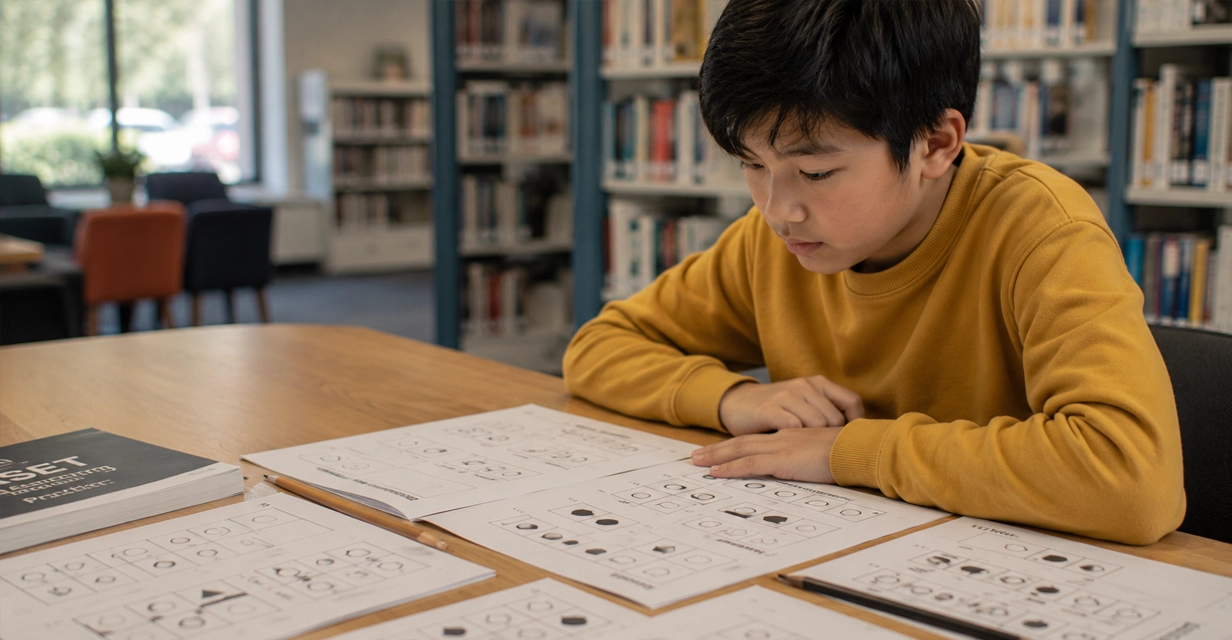
Data interpretation questions present a small table, chart or graph and ask your child to read information from it and reason with it, such as finding a difference, a total or a comparison. Alongside these sit problems involving measurement, money, time, fractions, ratios and basic logic, each requiring the child to apply familiar maths to an unfamiliar wrapping.
The unifying thread is decision making under time pressure. None of these types demands advanced computation, but all of them demand that your child quickly recognise what is being asked and which operation answers it. Teaching your child to name the type of question in front of them, then reach for the matching strategy, is one of the most effective ways to lift their speed and accuracy together.
Why Strong Maths Students Still Lose Marks Here
Strong maths students often lose marks in quantitative reasoning because they are excellent at calculating but slower at deciding, and this section rewards deciding. A child can be the quickest in their class at sums and still struggle when nobody tells them which sum to do.
This is the insight that reframes the whole section. The children who find quantitative reasoning hardest are usually not weak at maths at all. They are products of a school system that trains accurate calculation and rarely trains problem selection. When the instruction disappears, their greatest strength is suddenly not the thing being measured, and a confident student can be left unsure where to begin.
Careless reading is the other great thief of marks. Because the questions are wrapped in words and data, a child who rushes can answer a slightly different question than the one asked. A common trap is calculating a total when the question wanted the difference, or the amount remaining, and the maths is flawless while the answer is wrong. Order of operations errors strike in the same way when a problem involves several steps.
Time pressure magnifies both problems. At roughly one minute per question, a strong student who is used to getting everything right may spend too long perfecting a hard question early on, then run short of time for easier marks waiting later in the section. Perfectionism, normally an asset, becomes a liability.
The encouraging takeaway is that none of this reflects a ceiling on your child’s ability. These are habits, and habits respond to practice. A capable young mathematician who learns to decode problems, read precisely and pace themselves will usually turn quantitative reasoning from a weakness into one of their stronger sections.
How to Build Your Year 6 Child’s Quantitative Reasoning Skills
You build a Year 6 child’s quantitative reasoning skills by practising problem selection and mental maths, not by drilling harder calculations. The aim is to grow the ability to read a problem, choose the right operation, and carry it out confidently in their head.
Start with translation, which is the core skill. Give your child word problems and, before any answer, ask them simply to say what the question is really asking and which operation will answer it. Spending time on this decision, rather than rushing to compute, trains the exact muscle the section tests and quickly reduces careless mistakes.
Strengthen mental maths in parallel, because speed without a calculator underpins everything. Short, regular practice of quick addition, subtraction, multiplication and division, along with times tables and simple fractions, frees up your child’s thinking for the reasoning rather than the arithmetic. A child who calculates effortlessly has more attention to spend on choosing the right path.
Teach precise reading as a deliberate habit. Encourage your child to underline or note exactly what each question asks, especially words such as difference, remaining, total or each, and to check their final answer against that wording before moving on. This single discipline prevents the most frequent and frustrating errors in the section.
Finally, build variety into practice so your child meets every question type often. Mixing word problems, patterns, data interpretation and logic within a session teaches them to switch approaches fluidly, which is what the real test demands. For families who want a clear structure and expert insight into where a child is going wrong, a tutoring centre experienced in ASET maths preparation can pinpoint the specific habits to fix and keep the practice on track.
ASET Maths Preparation in WA: A Weekly Practice Plan
Effective ASET maths preparation in WA is steady and spaced, because reasoning skills grow through short, frequent sessions far better than through occasional long ones. A calm routine over several months will always outperform a last minute rush.
Aim for several short sessions a week. Three blocks of around 25 to 30 minutes will build more genuine reasoning ability than one tiring session at the weekend, because the brain consolidates these skills through repeated, spaced exposure. Shorter sessions also keep a Year 6 child fresh and willing, which matters over a long preparation period.

Split each session sensibly. A few minutes of brisk mental maths to warm up, followed by a set of mixed quantitative reasoning questions, then a careful review of any mistakes, makes for a balanced workout. The review is the most valuable part, because understanding why an answer was wrong teaches far more than simply marking it.
Introduce timing gradually. Early on, let your child work without a clock so they can focus on choosing the right approach, then slowly add time pressure until they are comfortable at around one minute per question. This staged build develops speed without breeding anxiety, and it mirrors how the real section feels.
Keep the experience positive and sustainable. For families across Canning Vale, Harrisdale and the wider southern suburbs balancing school, activities and a months long preparation runway, the routine only holds if your child does not come to dread it. Treat the harder problems as puzzles to crack, praise good reasoning even when the final answer slips, and protect a consistent weekly rhythm. That steady, encouraging pattern of GATE quantitative reasoning practice is what carries a child confidently toward test day.
Test Day Strategy for Quantitative Reasoning
A strong test day strategy for quantitative reasoning is about pacing and precision, because the section rewards collecting every available mark rather than perfecting any single hard question. With about one minute per question and rising difficulty, how your child manages time matters as much as how they calculate.
Use a first pass and second pass approach. On the first pass, your child answers every question they can solve comfortably and skips anything that does not yield quickly, marking it to revisit. Because the harder questions cluster later in the section, this ensures they secure the easier marks throughout rather than getting trapped on a single problem and running out of time.
Read every question twice before answering. The most common test day error is solving the wrong question, so a quick second read to confirm exactly what is asked, the difference, the total, the amount each, protects against flawless maths producing a wrong answer. This habit costs seconds and saves marks.
Never leave a question blank. The ASET does not penalise incorrect answers, so when a question remains unclear on the second pass, your child should eliminate any clearly wrong options and choose from the rest. An educated guess is always worth more than an empty space.
Above all, encourage calm and momentum. A child who has practised steadily walks in trusting their preparation, moves briskly without panic, and treats each problem as a familiar type rather than a fresh threat. That settled confidence, built over months of the right practice, is the quiet advantage that lets a well prepared child perform at their true level on the day.
Ready to get started?
Experience a full week of
GATE WA tutoring at no cost.
Conclusion
Quantitative reasoning surprises Perth families because it wears the clothes of school maths while testing something quite different: not how well your child calculates, but how well they decide what to calculate, and how quickly they can do it in their head. That is why confident young mathematicians can stumble, and why the right preparation looks nothing like endless calculation drills.
Focus on the skills that actually move the score. Help your child translate worded and unfamiliar problems into the right operation, sharpen their mental maths, read each question with precision, and pace themselves so no single problem swallows their time. Short, regular, well reviewed practice across several months will achieve far more than any frantic final push.
Approach it this way and the section that once looked daunting becomes one of your child’s strengths. Your Year 6 child walks into the ASET able to see what each problem is really asking, to choose their method with confidence, and to earn the full quarter of the score that quantitative reasoning is worth.
Get in touch today for a free consultation to explore how we can support your child’s GATE WA journey.
Helpful Links for Parents
Gifted and Talented Secondary Selective Entrance programs, application and testing information, WA Department of Education
https://www.education.wa.edu.au/giftedandtalented
Apply for Gifted and Talented Secondary Selective Entrance programs, WA Government
https://www.wa.gov.au/service/education-and-training/school-education/apply-gifted-and-talented-secondary-selective-entrance-programs
Australian Council for Educational Research (ACER), the body that develops and administers the ASET
https://www.acer.org
Resources Used
Australian Council for Educational Research (ACER), ASET structure, section timing and format.
WA Department of Education, Gifted and Talented Secondary Selective Entrance programs and Year 7 entry process.
Published WA GATE and ASET quantitative reasoning preparation guidance, including question types and common errors, 2026.