Currently Empty: $0.00
Dr. Arti Verma
- May 28, 2026
- Comment 0
Inside the ASET Abstract Reasoning Section
How to Train Your Year 6 Child
Table of Contents
- Introduction
- What Is the ASET Abstract Reasoning Section?
- What Question Types Appear in ASET Abstract Reasoning?
- Why Abstract Reasoning Catches So Many Year 6 Students Off Guard
- How to Train Your Year 6 Child for Abstract Reasoning
- Abstract Reasoning Practice for GATE WA: Building a Weekly Routine
- Test Day Strategy for the Abstract Reasoning Section
- Conclusion
- Helpful Links for Parents
- Resources Used
Introduction
Across Perth, plenty of capable Year 6 children sit down to their first abstract reasoning question and simply freeze. They are strong readers. They are confident in maths. Yet this part of the ASET looks like nothing they have ever seen at school, and that unfamiliarity alone can cost them marks they were more than smart enough to earn.
That is the strange thing about ASET abstract reasoning. It is not testing what your child has learned. It is testing how they think when the content is stripped away, using shapes, patterns and sequences rather than words or numbers. For a child who has never met these puzzles before, the novelty is the real obstacle, not the difficulty.
The good news is that this is the most trainable section of the whole test. Because the challenge is mostly unfamiliarity, the single most useful thing a parent can do is remove that unfamiliarity through steady, structured practice. A child who has seen the patterns many times before walks in calm, while an equally bright child who has not can lose precious time and confidence.
This guide takes you inside the abstract reasoning section. It explains what it is, the question types your child will face, why it trips so many students up, and a clear, practical plan for how to prepare for ASET in Perth so your Year 6 child arrives ready rather than rattled.
What Is the ASET Abstract Reasoning Section?
The ASET abstract reasoning section is a fast, nonverbal test of pattern recognition and logical thinking, made up of 35 multiple choice questions to be answered in just 20 minutes. It measures how well a child can spot rules and relationships using shapes and figures, with no reading or arithmetic involved.
It sits inside the wider Academic Selective Entrance Test, administered by the Australian Council for Educational Research for entry into GATE programs and Perth Modern School. Children sit the ASET in Year 6 for a Year 7 placement, and the full test runs for around two hours and forty five minutes across four sections: reading comprehension, writing, quantitative reasoning and abstract reasoning.
The detail that matters most here is the clock. Abstract reasoning gives roughly 34 seconds per question, making it by some distance the fastest paced section of the test. There is no time to puzzle slowly. A child needs to see the rule almost immediately, choose, and move on.
Weighting raises the stakes further. Each of the four sections carries equal weight in the Total Standard Score, the single number out of 400 that decides placement. A child who is excellent in three sections but unprepared for abstract reasoning surrenders a full quarter of their potential score, which can be the difference between an offer and a near miss.
So this is a short, sharp, high value section that rewards familiarity and speed. Understanding exactly what it asks is the first step to training for it well.
Ready to get started?
Experience a full week of
GATE WA tutoring at no cost.

What Question Types Appear in ASET Abstract Reasoning?
Abstract reasoning questions come in a handful of recurring families, and once your child can recognise each one on sight, the section becomes far less intimidating. Every question hides a rule, and the task is always the same: work out the rule, then apply it.
The most common type is the sequence. Your child sees a row of figures that change according to a hidden pattern and must choose the figure that comes next. The rule might involve a shape rotating, an element being added each step, or shading shifting from one position to the next.
Matrices are the second major family. Here a grid, usually three by three, has one cell left blank, and your child must find the figure that completes the pattern running across the rows and down the columns at the same time. These reward children who learn to check more than one direction before answering.
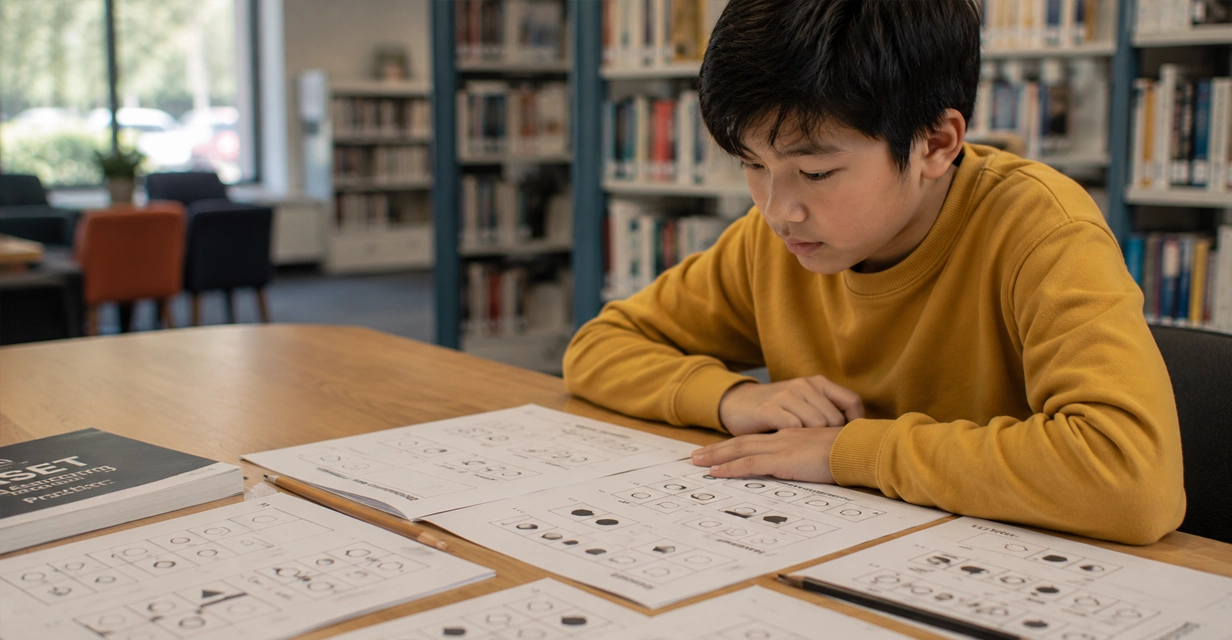
Then come odd one out questions, where several figures share a rule and one breaks it, and analogies, which follow the logic of figure A relates to figure B in the same way that figure C relates to a missing figure. Spatial questions round out the set, asking a child to picture rotations, reflections or folding in their head.
The rules themselves are surprisingly limited once you name them. They almost always involve changes in shape, number, size, shading, position or rotation. Teaching your child to scan for those six things turns a frightening pile of strange pictures into a short checklist they can run through quickly and confidently.
Why Abstract Reasoning Catches So Many Year 6 Students Off Guard
Abstract reasoning catches Year 6 students off guard because it is the section least like anything they do at school, so even strong students meet it cold. Classrooms build knowledge, while this section deliberately removes knowledge and tests raw reasoning, which is a genre most children have simply never practised.
The novelty is the core problem. A child who has spent years answering reading and maths questions has a feel for those formats, but abstract patterns are foreign territory. Faced with the unknown under a ticking clock, even a bright, calm student can panic, and panic is expensive when each question lasts around 34 seconds.
Speed compounds it. In the reading and quantitative sections a child has roughly a minute per question, but abstract reasoning nearly halves that. A student who is meeting the format for the first time on test day will inevitably move too slowly, run out of time, and leave easy marks unanswered at the end.
There is a confidence dimension too. Because these puzzles feel so different, a child who stumbles early can decide they are simply bad at this section and carry that doubt through the rest of the test, where it quietly drags down their performance in areas they would normally find easy.
Here is the insight that should reassure you. The gap between a prepared and an unprepared child is widest in exactly this section, and it is not a gap in intelligence. It is a gap in familiarity. Two equally clever children can sit the same paper, and the one who has simply seen these patterns before will glide through while the other freezes. That means the score is highly winnable through preparation, because you are not trying to make your child smarter, only to make the unfamiliar familiar.
How to Train Your Year 6 Child for Abstract Reasoning
You train a Year 6 child for abstract reasoning by removing novelty and building speed, in that order. First make every question type feel familiar, then gradually add time pressure, so that on test day nothing surprises them and their hands move quickly.
Start slowly and untimed. In the early weeks, let your child work through abstract reasoning questions with no clock at all, focusing entirely on understanding. The goal at this stage is for them to learn the families from the previous section and to get comfortable asking the one question that unlocks almost every item: what is changing from one figure to the next.
Teach the rule first habit explicitly. The most powerful strategy in this section is to identify the rule before looking at the answer options, because glancing at the choices too early invites guessing and confusion. Train your child to study the pattern, decide what the answer should look like, and only then scan the options for a match. This single habit lifts both speed and accuracy.
Build a scanning checklist. Since the rules almost always involve shape, number, size, shading, position or rotation, your child can run through that short list on any question they find hard. Having a fixed method to fall back on stops them from freezing when a puzzle looks strange, which is precisely when most marks are lost.
Only once understanding is solid should you introduce the clock. Move from untimed practice to a generous time limit, then tighten it gradually toward the real 34 seconds per question. This staged approach builds genuine speed without the anxiety that comes from rushing a child who is still learning the patterns. For families who want a clear structure and expert feedback on where a child is getting stuck, working with a tutoring centre experienced in ASET preparation can make this far easier to sustain.
Abstract Reasoning Practice for GATE WA: Building a Weekly Routine
The best abstract reasoning practice for GATE WA is little and often, because short, regular sessions build pattern recognition far better than occasional long ones. Consistency over several months turns strange puzzles into familiar friends, which is exactly the outcome you want.
Aim for short, frequent sessions. Three sessions of around 20 to 30 minutes across a week will achieve more than a single exhausting block at the weekend, because abstract reasoning is a skill of recognition that strengthens through repeated, spaced exposure. A young child also stays fresher and more positive with shorter bursts.
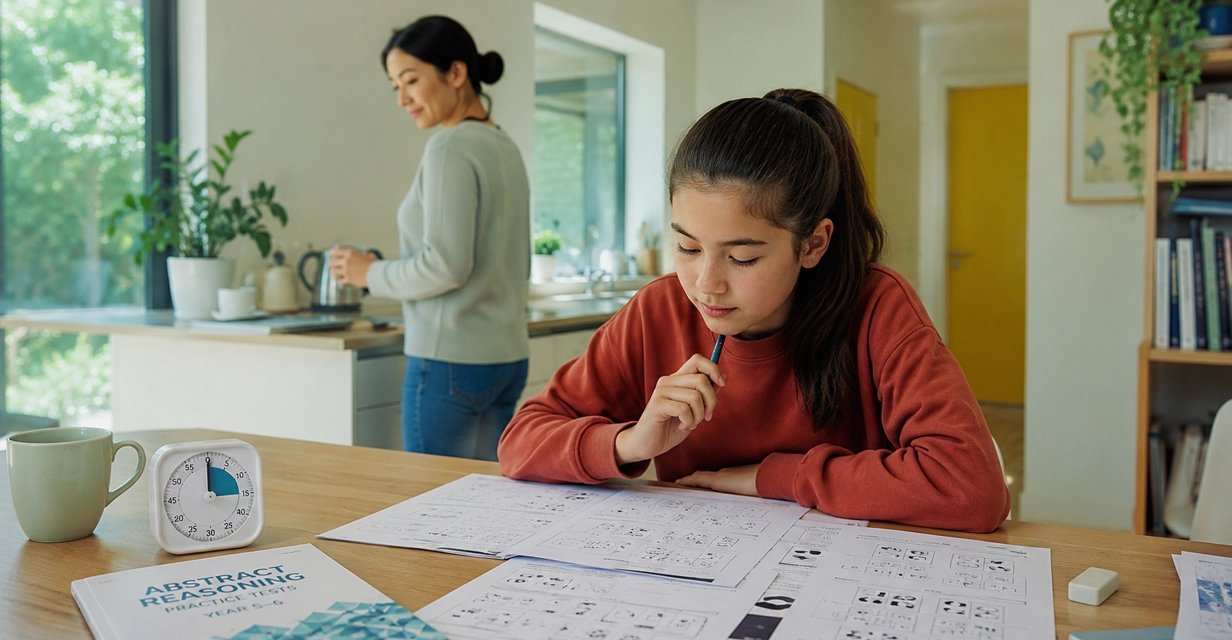
Mix the question types deliberately. Rather than drilling only sequences for a fortnight, blend sequences, matrices, odd one out, analogies and spatial questions within each session, so your child learns to switch between rules quickly. The real test jumps between types without warning, and practice should mirror that.
Review every mistake, because the wrong answers are where the learning lives. When your child misses a question, the valuable step is working out which rule they overlooked, not simply noting that they were wrong. Many families spread this preparation across several months in the lead up to the test, and while some invest well over a hundred hours, the children who improve most are those whose practice is targeted and reviewed, not merely long.
Keep the tone light. For families across Canning Vale, Harrisdale and the wider southern suburbs juggling school, sport and a long preparation runway, the routine only works if your child does not come to dread it. Frame the puzzles as games, celebrate the moment a tricky pattern clicks, and protect a steady rhythm rather than chasing a frantic final sprint. A calm, consistent build is what carries a child confidently to test day.
Test Day Strategy for the Abstract Reasoning Section
A strong test day strategy for abstract reasoning is built around speed and momentum, never perfectionism, because with around 34 seconds per question, getting stuck is the single biggest danger. The aim is to keep moving and to finish, not to agonise over any one puzzle.
Use a first pass and second pass approach. On the first pass, your child answers every question they can solve quickly and skips anything that does not reveal its rule within a few seconds, marking it lightly to return to. This guarantees they collect all the easy marks before time runs short, rather than stalling early and never reaching gettable questions at the end.
Apply the rule first habit under pressure. The method practised at home matters most here: study the pattern, decide what the answer should be, then find it among the options. A child who has rehearsed this will not be lured into slow second guessing when the clock is loud in their head.
Never leave a question blank. Because the ASET does not penalise wrong answers, an educated guess is always better than an empty space. Train your child that if a question is still unclear on the second pass, they should eliminate any obviously wrong options and choose from what remains, then move on without regret.
Finally, treat it as a game rather than an exam. The children who do best in this section are those who stay relaxed, trust their preparation, and keep up a brisk, almost playful pace. A child who has practised steadily for months walks in knowing the patterns are old friends, and that quiet familiarity is the strongest test day advantage of all.
Ready to get started?
Experience a full week of
GATE WA tutoring at no cost.
Conclusion
Abstract reasoning is the section of the ASET that surprises the most Year 6 children, but it is also the most winnable, precisely because the challenge is unfamiliarity rather than intelligence. A bright child who has never seen these patterns can freeze, while an equally bright child who has practised them glides through at speed. The difference is preparation, and preparation is entirely within your reach.
Keep the plan simple. Help your child learn the handful of question types, teach the habit of finding the rule before looking at the options, build a scanning checklist for when a puzzle looks strange, and add time pressure only once understanding is solid. Short, regular, reviewed practice across several months will do far more than any last minute cramming.
Do that, and the section that once looked like a wall of strange shapes becomes a set of familiar, almost enjoyable puzzles. Your child walks into the ASET calm, quick and confident in abstract reasoning, ready to earn the full quarter of the score this section is worth.
Get in touch today for a free consultation to explore how we can support your child’s GATE WA journey.
Helpful Links for Parents
Gifted and Talented Secondary Selective Entrance programs, application and testing information, WA Department of Education
https://www.education.wa.edu.au/giftedandtalented
Apply for Gifted and Talented Secondary Selective Entrance programs, WA Government
https://www.wa.gov.au/service/education-and-training/school-education/apply-gifted-and-talented-secondary-selective-entrance-programs
Australian Council for Educational Research (ACER), the body that develops and administers the ASET
https://www.acer.org
Resources Used
Australian Council for Educational Research (ACER), ASET structure, section timing and format.
WA Department of Education, Gifted and Talented Secondary Selective Entrance programs and Year 7 entry process.
Published WA GATE and ASET preparation guidance on abstract reasoning question types and pacing, 2026.