Currently Empty: $0.00
Dr. Arti Verma
- June 16, 2026
- Comment 0
Help Your Child With Maths
Homework You Do Not Understand
Table of Contents
- Introduction
- Do You Really Need to Understand the Maths to Help?
- Why Your Attitude Matters More Than Your Knowledge
- The Mistake to Avoid: Teaching It the Way You Learned It
- How to Help Your Child With Maths Homework Step by Step
- Powerful Questions to Ask When You Are Stuck Too
- Where to Find the Method When Neither of You Knows It
- When to Step Back, and When to Get Extra Help
- Conclusion
- Helpful Links for Parents
- Resources Used
Introduction
It happens to almost every parent eventually. Your child slides their maths homework across the table, asks for help, and you look down at a page that may as well be written in another language. The methods are unfamiliar, the symbols have changed, and a quiet panic sets in. How are you supposed to help with something you no longer understand yourself?
Take a breath, because here is the genuinely good news. Knowing how to help your child with maths homework has surprisingly little to do with whether you can solve the problem. Some of the most useful help a parent can give requires no maths knowledge at all.
Even better, research suggests that what you bring to the table matters far more than your ability to find the answer. Your calm, your encouragement and the questions you ask shape your child’s learning in ways that solving the problem for them never could.
This guide shows you exactly how. It explains why you do not need to understand the maths, why your attitude matters most, the one common mistake to avoid, and a simple, practical approach you can use even when you are completely stuck too. By the end, that unfamiliar homework page will feel far less frightening. If a bigger picture question about timing is also on your mind, when to start tutoring in primary school is a useful companion guide. If homework battles are also a regular feature of your evenings, how to end the nightly homework battle without the tears and the tantrums addresses the environment side of this challenge alongside the maths side. Visit Champion Tutors to learn how we support primary families across Perth.
Do You Really Need to Understand the Maths to Help?
No, you do not need to understand the maths to help your child with their homework. The most valuable support a parent gives is rarely about supplying the answer, and a parent who cannot solve the problem can still help enormously in other ways.
This feels counterintuitive, because we naturally assume helping means knowing. But think about what a struggling child actually needs. They need someone to keep them calm, to encourage them to keep trying, to prompt them to explain their thinking, and to help them find the right method, none of which requires you to be able to do the maths yourself.
In fact, not knowing the answer carries a hidden advantage. A parent who can solve the problem is tempted to take over and simply do it, which teaches the child very little. A parent who cannot is forced into the far more useful role of guide, helping the child work it out for themselves.
So the question is not whether you understand the maths, but whether you can support your child’s thinking and protect their confidence. Those are things any parent can do, regardless of how long ago they last touched algebra. The rest of this guide shows you how to play that role well. You can explore our tutoring programs to see how our tutors build that same guiding approach systematically across every primary year level.
Why Your Attitude Matters More Than Your Knowledge
Your attitude towards maths matters far more than your knowledge of it, because children absorb how you feel about maths even more readily than what you know. A calm, positive parent helps, while an anxious one can unintentionally pass that anxiety on.
This is not just encouragement, it is a research finding. A 2015 study in Psychological Science, led by Erin Maloney and colleagues at the University of Chicago, followed children across their early school years. It found that children of more maths anxious parents learned less maths and grew more anxious about it, but only when those parents frequently helped with maths homework.

The most striking detail is what did not matter. The parents’ actual maths knowledge had no effect on their children’s results. Only their level of maths anxiety did. In other words, it was not what parents knew that shaped their children, but the feelings they brought to the homework table.
The lesson is both clear and freeing. If you sit down tense, sighing that you were never any good at maths, your child absorbs that message. If you approach the same problem calmly and with curiosity, treating being stuck as a puzzle to solve rather than a disaster, you give your child something far more valuable than the answer. Your steady, positive presence is the real help. This is exactly the confidence-building approach described on our About Us page — it is the philosophy behind everything we do at our Harrisdale and Canning Vale centres.
The Mistake to Avoid: Teaching It the Way You Learned It
The most common mistake parents make is teaching maths the way they learned it decades ago, which often clashes with how it is taught today. This confuses children rather than helping them, even when your method reaches the right answer.
Maths teaching has changed considerably. Children today often learn through number lines, partitioning numbers into parts, visual models and strategies designed to build deep understanding, rather than the rote procedures many parents grew up with. The long division or column method you remember may look nothing like what your child is being shown.
When you teach your old method, you can unintentionally create a clash. Your child now has two competing approaches in their head, yours and the teacher’s, and a young learner often cannot reconcile them. The result is a more confused, not less confused, child, even though your maths was perfectly correct.
This is where not knowing the modern method is quietly helpful. Rather than imposing your own way, you are free to help your child uncover the method they have actually been taught. So if your instinct is to say let me show you how I do it, gently resist it. The goal is to help your child use their method, not to replace it with yours. Our FAQs page covers questions about how the WA primary maths curriculum is structured today, which can help you understand what methods your child is being taught at each year level.
Ready to get started?
Experience a full week of
tutoring at no cost.

How to Help Your Child With Maths Homework Step by Step
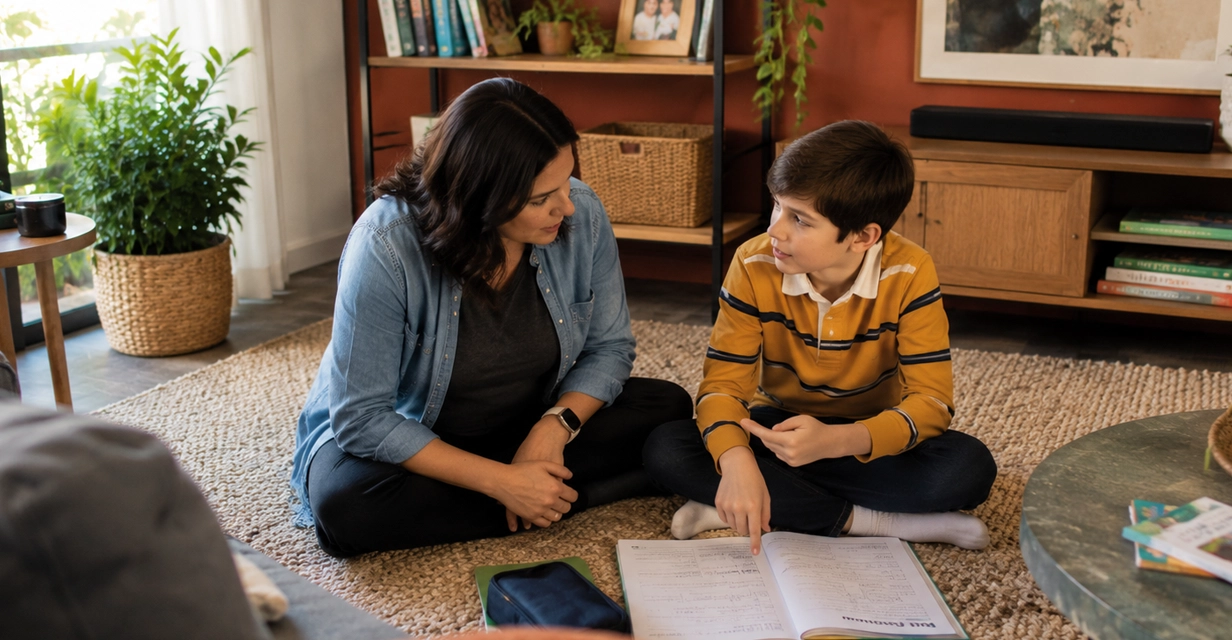
The best way to help with maths homework you do not understand is to guide your child to their own answer, calmly and patiently, rather than trying to teach the content. A simple, repeatable approach works for almost any problem.
Start by staying calm and setting the tone. Before anything else, take the pressure off by treating the problem as something the two of you will figure out together. A warm, unhurried start does more for your child than any explanation, because it keeps their mind open rather than anxious.
Then ask your child to be the teacher. Have them show you what they have learned in class and explain how they think the problem works, because explaining out loud is one of the most powerful ways for a child to consolidate understanding. Often a child talks their way to the answer simply by describing it to you.
If they are stuck, help them find the method rather than supplying it. Look together at their workbook, class notes or examples for a similar problem they can follow, so the correct approach comes from their own materials. Work through that example slowly, then let them apply it to the homework question themselves.
Finally, let them do the actual work. Resist the urge to take the pencil, even when it would be faster, because the learning happens when your child does it, not when they watch you. Your job is to guide, prompt and encourage, while their job is to think and write. You can also download our free sample papers to see what level your child is working at and identify where the specific gaps might be before the next homework session.
Powerful Questions to Ask When You Are Stuck Too
When you are stuck too, the right questions are far more useful than any answer, because good questions help a child think their way forward. You can guide a child through a problem you cannot solve simply by asking, not telling.
A few questions work for almost any maths problem. Asking what the question is really asking helps a child slow down and understand the task. Asking what they already know, or what they did in class with a problem like this, prompts them to reach for the method they have been taught.
Other questions keep the thinking moving. What do you think the first step might be invites them to start, while what could we try here gives them permission to attempt something without fear of being wrong. When they make a move, asking how they worked that out encourages them to check and explain their reasoning.
The beauty of this approach is that it works no matter how lost you are personally. You are not providing the maths, you are providing the thinking prompts, and the child supplies the content. Even better, you are teaching a skill far more valuable than any single homework answer: how to approach a hard problem calmly and methodically. That is a habit your child will use for the rest of their life, and exactly the kind of independent thinking our tutors in Hammond Park and Piara Waters build in every session.
Where to Find the Method When Neither of You Knows It
When neither you nor your child can find the method, there are plenty of reliable places to look it up together, which models a wonderful skill: knowing how to find out. Being stuck is not the end of the road, just the start of a search.
The first place to look is always your child’s own materials. Their workbook, class notes and any worked examples the teacher has provided show the exact method being taught, so finding a similar solved problem there is usually the quickest and safest route to the right approach.

Reputable online resources can help too, provided you choose carefully. Educational sites and clearly explained tutorials can demonstrate current methods, though it is worth checking that the approach matches what your child learns at school, since methods vary. Looking these up together also shows your child that adults do not know everything, and that finding out is part of learning.
The teacher remains your best long term ally. If a particular type of problem keeps stumping you both, a quick note to the teacher asking how it is taught in class is completely reasonable, and most teachers are glad to help. Seeking out the method together, rather than guessing or giving up, teaches your child resourcefulness, which is worth far more than any single answer. If maths homework regularly takes far longer than it should and the method cannot be found, signs your child needs a tutor can help you assess whether a foundational gap is making all of this harder than it should be.
Ready to get started?
Experience a full week of
tutoring at no cost.
When to Step Back, and When to Get Extra Help
Sometimes the best help is to step back, and occasionally it is to bring in extra support. Knowing the difference protects both your child’s confidence and your relationship with them, especially around homework.
Step back when homework is turning into conflict. If a session is dissolving into tears or frustration on either side, pushing on rarely helps, and it can make a child associate maths with stress. It is perfectly fine to pause, take a break, and let your child attempt what they can alone, then leave the rest for the teacher. An honest note saying your child tried but got stuck is genuinely useful feedback for the teacher.
Watch too for signs that the gap is bigger than homework help can fix. If your child is consistently lost, falling behind, or losing confidence in maths despite your support, the issue may be a foundational gap that needs focused, patient attention you are not positioned to give. That is not a failure on your part, simply a recognition of what the situation needs. For a fuller checklist, signs your child needs a tutor can help you confirm what you are seeing.
This is where a good tutor can help, especially one experienced with primary maths and the way it is taught today. For families across the southern suburbs, a patient tutor who can rebuild a shaky foundation and restore a child’s confidence often achieves what nightly homework battles cannot. When you reach that point, when to start tutoring in primary school helps you judge the right timing, and families nearby can find primary school tutoring in Canning Vale and nearby suburbs close to home. If you reach that point, how to choose a tutor in Perth can help you find the right fit. Stepping back from the role of teacher, so you can simply be the encouraging parent again, is sometimes the most helpful move of all.
Conclusion
If your child’s maths homework has left you feeling helpless, remember the most liberating truth in this guide: you do not need to understand the maths to help. The research is clear that your knowledge is not what shapes your child’s learning, but your attitude is, so a calm, encouraging presence matters more than any answer.
Help by guiding rather than teaching. Stay positive, ask good questions, let your child be the teacher, and look up the method together in their own materials when you are both stuck. Avoid the trap of teaching it the way you learned it, since methods have changed, and let your child do the actual thinking and writing.
Above all, protect your child’s confidence and your relationship with them. Step back when homework turns into conflict, and consider a patient tutor if the gap runs deeper than homework help can reach. When you do, why top marks do not mean good teaching is worth a read, so you judge a tutor by more than results alone. Approached this way, you can support your child beautifully through maths you have long forgotten, and teach them something more valuable still: how to stay calm and resourceful in the face of a hard problem.
Get in touch today for a free consultation if homework has become a regular battle and you would like an extra pair of hands.
Helpful Links for Parents
The Western Australian mathematics curriculum, to see how maths is taught today, School Curriculum and Standards Authority (SCSA)
https://k10outline.scsa.wa.edu.au
Resources to support a positive attitude to maths at home, youcubed, Stanford University
https://www.youcubed.org
Support for your child’s learning at home, WA Department of Education
https://www.education.wa.edu.au
Resources Used
Maloney, Ramirez, Gunderson, Levine and Beilock, intergenerational effects of parents’ maths anxiety on children’s maths achievement and anxiety, Psychological Science, 2015, University of Chicago.
School Curriculum and Standards Authority (SCSA), the Western Australian mathematics curriculum and current teaching methods.
Research on parental involvement in homework and the benefits of children explaining their reasoning.