
Subtotal: $1,400.00
Dr. Arti Verma
- June 18, 2026
- Comment 0
How to End the Nightly Homework Battle
Without the Tears and the Tantrums
Table of Contents
- Introduction
- Why Do Homework Battles Happen in the First Place?
- What the Research Says About Homework and Stress
- Set a Consistent Routine That Removes the Daily Argument
- Manage Energy: Timing, Food and Breaks
- Give Your Child Autonomy Within Clear Boundaries
- Change Your Role From Enforcer to Supporter
- When the Homework Itself Is the Problem
- Conclusion
- Helpful Links for Parents
- Resources Used
Introduction
If your evenings have become a battlefield over homework, you are far from alone. In homes across Perth, the same scene plays out night after night: the reminding, the resisting, the tears, the slammed pencil, and a parent left feeling like the bad guy at the end of a long day. Homework battles with a child can drain a whole family.
The exhausting part is that it rarely feels like it should be this hard. A twenty minute worksheet somehow expands into a two hour standoff, and by the end nobody has learned much except how to argue. It can leave you wondering whether you are doing something wrong as a parent.
You are not. Homework battles are extremely common, and they usually have less to do with your parenting or your child’s character than with a few fixable conditions underneath the conflict. Change those conditions, and the battle often fades on its own.
This guide shows you how to end the nightly struggle without the tears and the tantrums. It explains why these battles happen, what the research says about homework and stress, and the practical changes, from routine to autonomy to your own role, that can turn homework from a war zone back into a calm part of the day. If maths is the usual flashpoint in your house, how to help your child with maths homework pairs well with this guide.
Why Do Homework Battles Happen in the First Place?
Homework battles usually happen because of a mismatch between the task and the child’s state, combined with a power struggle, rather than because a child is simply being difficult. Understanding the real causes is the first step to ending the fight.
Tiredness is the most common culprit. After a full day at school, a child’s willpower and focus are nearly empty, so asking them to sit and concentrate again can feel, to them, genuinely overwhelming. Younger children especially find it hard to summon focus on demand, and resistance is often exhaustion in disguise.
A power struggle frequently sits underneath as well. Homework is one of the few areas where a child can push back and exert control, so battles often become less about the maths and more about autonomy. The harder a parent pushes, the harder a child digs in, and a simple task becomes a contest of wills.
Other triggers add fuel. Work that is too hard sparks frustration, work that is boring or feels pointless sparks resistance, and hunger or a lack of any break after school leaves nothing in the tank. Seen this way, the battle is rarely defiance for its own sake. It is a signal that something in the setup needs to change, which is exactly what the rest of this guide addresses. If you are wondering whether the homework difficulty is also a sign of a deeper academic gap, signs your child needs a tutor can help you assess what you are seeing. Families in Harrisdale and nearby suburbs can book a free assessment at our local centre to check.
What the Research Says About Homework and Stress
The research offers reassuring perspective: at primary level, homework has only a small academic benefit, and too much of it raises family stress without improving learning. Knowing this helps you keep the nightly struggle in proportion.
Decades of work by Harris Cooper, a Duke University professor who literally wrote a book called The Battle Over Homework, found that homework has minimal academic benefit for children in the early primary years, with the benefits growing only as children get older. This is partly because younger children are less able to tune out distractions and have less developed study habits.
There is also a widely used guideline known as the 10 minute rule, endorsed by leading education and parent bodies, which suggests roughly 10 minutes of homework per night for each grade level. Beyond that level, the evidence points to diminishing returns and even negative effects, particularly stress.
Yet many children receive far more. One study of over a thousand families found that primary children were often given up to three times the recommended amount, and that as the homework load rose, so did family stress. Researchers have also found that only around a quarter of students feel their homework is meaningful.
The takeaway is freeing. Protecting your child’s wellbeing and their love of learning is not going soft, it is supported by the evidence. A calm, reasonable approach to primary homework is not just easier on everyone, it is genuinely better for your child. Our programs page shows how we structure our sessions to keep the workload appropriate and purposeful at every year level, which is the same principle that applies at home.
Set a Consistent Routine That Removes the Daily Argument
A consistent daily routine is the single most powerful way to end homework battles, because it removes the nightly negotiation that sparks so many of them. When homework simply happens at a set time, there is far less to argue about.
The reason is psychological. Every day that homework is up for debate, your child has the chance to resist, stall and bargain, which is exhausting for everyone. A fixed routine takes the decision off the table, so homework becomes a normal, expected part of the day rather than a fresh battle to be fought each evening.

Build the routine around the same time and place. Choose a regular slot that suits your child’s energy, set up a calm, consistent spot with the distractions removed, and keep it the same each day so the habit takes hold. Like brushing teeth, a well established routine eventually runs on autopilot, with little prompting needed.
Keep it realistic and humane. Anchor homework to something that already happens, such as after afternoon tea, rather than squeezing it into a tired, late slot. For young children especially, short is better, and a routine that respects the 10 minute guideline will feel achievable rather than daunting. A predictable, sensible routine quietly removes most of the friction before it can start. This same consistency is why families in Canning Vale and Piara Waters find that a regular weekly tutoring session helps establish that predictable rhythm that carries over into home study habits too.
Ready to get started?
Experience a full week of
tutoring at no cost.

Manage Energy: Timing, Food and Breaks
Managing your child’s energy is just as important as managing the task, because a tired, hungry child cannot concentrate no matter how willing they are. Many homework battles are really energy problems in disguise.
Timing matters enormously. The moment a child walks in the door, drained from a full school day, is usually the worst possible time to demand more focus. A short break to decompress, move around or simply rest first often transforms their willingness, turning a guaranteed fight into a manageable task.
Food and rest do real work too. A hungry child is an irritable, unfocused child, so a snack before homework can settle a great deal of resistance before it begins. Likewise, a child who has had no chance to play or unwind after school has nothing left to give, and asking them to push through only deepens the battle.
Build in breaks for longer tasks. Young children can only concentrate for short stretches, so breaking homework into small chunks with brief breaks between them keeps frustration low and focus higher. If your child is melting down, that is usually a sign to pause rather than push. Working with your child’s energy, rather than against it, prevents far more battles than any amount of insistence. These same principles of energy management are built into how we structure sessions at our Hammond Park and Kwinana centres — shorter, focused bursts with clear expectations and a calm environment.
Give Your Child Autonomy Within Clear Boundaries
Giving your child genuine autonomy within clear boundaries defuses the power struggle that drives so many homework battles. When a child feels some ownership over how homework happens, they have far less reason to fight it.
The principle is simple but powerful. The boundary, that homework does get done, is firm and not negotiable. But within that boundary, you hand your child real choices: which subject to start with, whether to work at the desk or the kitchen table, when within an agreed window to begin, and whether to do it in one block or two. These small choices restore a sense of control.

This matters because research on parenting consistently finds that autonomy supportive approaches, which offer children appropriate choice and ownership, are linked to better outcomes, while controlling, pressuring approaches are linked to worse ones. Letting a child steer the how, while you hold the whether, works with their development rather than against it.
It also shifts the dynamic away from confrontation. Instead of you imposing and your child resisting, the two of you are arranging how homework will happen, which feels collaborative rather than combative. A child who has been given some say is far more likely to follow through, because it has become partly their plan rather than entirely your demand. This is also how our tutors approach learning at our Canning Vale centre — children are given structured choices that build independent thinking over time. You can read more about our teaching philosophy on our About Us page.
Change Your Role From Enforcer to Supporter
One of the most effective changes you can make is to step out of the role of enforcer and into the role of supporter. When you stop being the homework police, much of the conflict loses its fuel.
The enforcer role traps you. The more you nag, hover and demand, the more homework becomes a battle between the two of you, and the more your child pushes back. It also strains your relationship, casting you as the adversary at the end of every day, which is exhausting and counterproductive for you both.
A supporter does something different. You set up the routine, make sure the conditions are right, and stay available to encourage and help if asked, but you let the homework itself be your child’s responsibility. This means allowing natural consequences too, so that if your child chooses not to do it, they explain that to their teacher rather than to you.
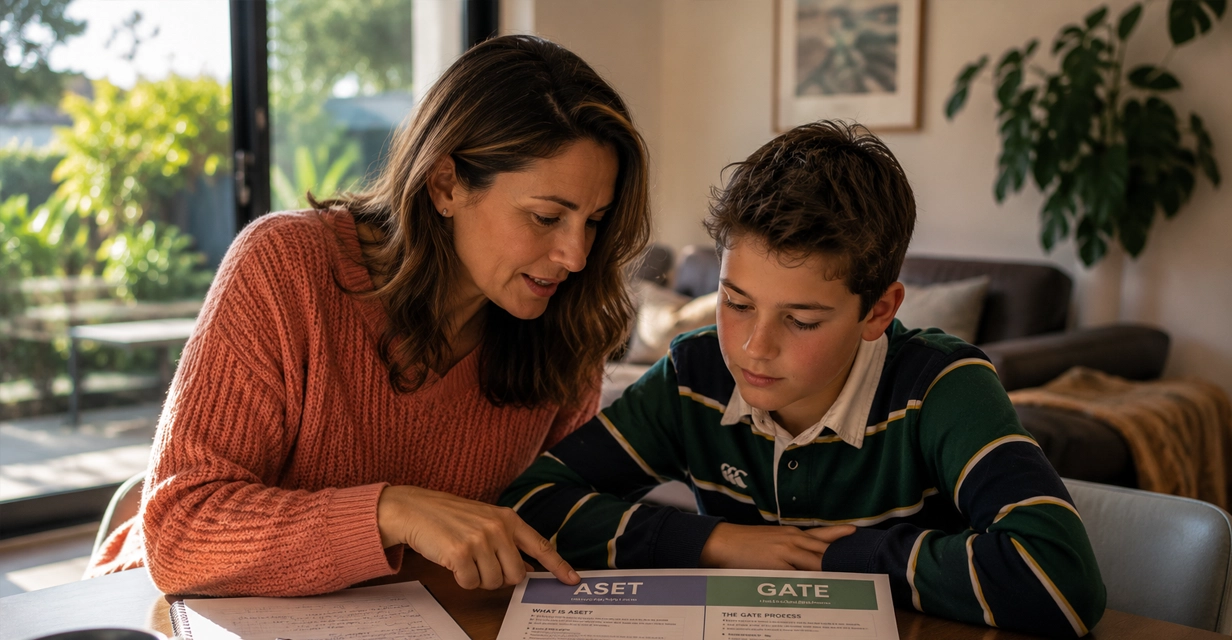
This shift protects your relationship and builds your child’s independence at the same time. Your job becomes creating the calm conditions for success and offering warmth and encouragement, not forcing compliance. Children rise to ownership more readily than to pressure, and a supportive parent who is on their side, rather than on their case, makes homework feel far less like a fight. For children also preparing for NAPLAN or GATE, these same independent study habits matter enormously — our ASET exam questions answered blog explains why self-directed practice is so important for the GATE pathway specifically.
Ready to get started?
Experience a full week of
tutoring at no cost.
When the Homework Itself Is the Problem
Sometimes the battle is not about routine or willpower at all, but about the homework itself being too much, too hard, or genuinely beyond your child. Recognising this protects your child and points you toward the right solution.
Watch for the telling signs. If a task that should take twenty minutes regularly stretches into an hour or more of struggle, if your child seems genuinely lost rather than simply reluctant, or if the volume far exceeds the gentle 10 minute per grade guideline, the problem may lie with the work, not your child’s attitude. If you are unsure which it is, signs your child needs a tutor can help you tell the difference.
When the load is the issue, the teacher is your ally. Since research shows many primary children receive far more homework than recommended, and that excessive homework raises family stress without improving learning, a calm conversation with the teacher about the amount is entirely reasonable. Teachers often appreciate knowing that a thirty minute task is taking hours at home.
When the difficulty is the issue, the answer is support rather than pressure. A child who battles homework because they have a genuine gap in understanding needs that gap addressed, not more insistence to keep trying. For families across the southern suburbs, a patient tutor can take this pressure off the household entirely, helping a child master the underlying skill so homework stops being a nightly source of distress. When to start tutoring in primary school helps you judge whether now is the right time, and families nearby can find primary school tutoring in Canning Vale and nearby suburbs close to home. If you reach that point, how to choose a tutor in Perth can help you find the right fit. Knowing when the homework, rather than the child, is the real problem is what lets you respond with the right kind of help.
Conclusion
The nightly homework battle is one of the most common struggles in family life, but it is also one of the most fixable. The fight is rarely about defiance. It is about tiredness, hunger, a task that does not fit, and a power struggle that grows the harder you push, all of which can be changed.
Focus on the conditions rather than the conflict. Set a consistent routine that removes the daily argument, work with your child’s energy through good timing, food and breaks, give them real autonomy within firm boundaries, and step from enforcer into supporter. And keep perspective, because at primary level the research is clear that a little homework done calmly beats a lot done in tears.
Above all, protect your child’s wellbeing and your relationship with them, because both matter far more than any single worksheet. When the homework itself is too much or too hard, talk to the teacher or seek support rather than pushing harder. Change the conditions, and the tears and tantrums fade, leaving homework as just another calm, ordinary part of your evening. If you are also thinking ahead about extra support, when to start tutoring in primary school can help you think through the timing.
Get in touch today for a free consultation if homework has become a nightly struggle and you would like a hand turning it around.
Helpful Links for Parents
Homework and study tips, and supporting your child’s learning, Raising Children Network, the Australian parenting website
https://raisingchildren.net.au
Support for your child’s learning at home, WA Department of Education
https://www.education.wa.edu.au
The Western Australian Curriculum, to understand what your child is learning, School Curriculum and Standards Authority (SCSA)
https://k10outline.scsa.wa.edu.au
Resources Used
Harris Cooper, Duke University, research on homework and achievement and the 10 minute rule, including the limited benefit of homework in the early primary years.
Pressman and colleagues, study on homework load and family stress, American Journal of Family Therapy, 2015.
Research on homework as a student stressor, and on autonomy supportive versus controlling parenting and children’s outcomes.