Currently Empty: $0.00

Dr. Arti Verma
- June 1, 2026
- Comment 0
ASET Writing: How to Help Your Child
Score Higher in 25 Minutes
Table of Contents
- Introduction
- How Is the ASET Writing Task Scored? The Levers That Matter
- The Single Biggest Way to Lose Marks, and How to Avoid It
- The 25 Minute Plan That Maximises Your Score
- The First Two Minutes: Planning for a Higher Mark
- Writing for Depth, Not Length
- The Last Two Minutes: Easy Marks in the Edit
- ASET Writing Practice That Builds Real Scores
- Conclusion
- Helpful Links for Parents
- Resources Used
Introduction
For parents across Perth preparing a child for the GATE test, the writing task can feel like the hardest part to influence. The other sections have right and wrong answers, but writing seems mysterious, and with only 25 minutes on the clock, it is hard to know what actually lifts a child’s mark. How do you help your child score higher in something so open ended?
The reassuring answer is that ASET writing is far more learnable than it looks, because the marks are not spread evenly across everything a child does. A handful of high leverage moves capture most of the available score, and they can be practised.
Better still, the two moves that lift a mark the most, planning at the start and editing at the end, are exactly the ones children skip under time pressure. The 25 minutes is usually won or lost at the beginning and the end, not in the middle.
This guide shows you how to help your child make those moves count. It explains how the ASET writing task is scored, the single biggest way to lose marks, a 25 minute plan that maximises the score, and how to practise for real gains. By the end, the writing task will feel less like a mystery and more like a set of clear, winnable steps.
How Is the ASET Writing Task Scored? The Levers That Matter
The ASET writing task is scored on how well a child selects, develops and organises ideas and communicates them clearly, alongside structure, vocabulary and accurate spelling and grammar. Crucially, these factors are not equal, so knowing which matter most lets your child spend their effort where it counts.
At the top of the list sits relevance to the prompt. Because writing judged off topic receives an automatic very low score, answering the prompt clearly is the foundation everything else rests on. No amount of polished language rescues a piece that drifts from what was asked.
Next comes the depth and quality of thinking. Markers reward thoughtfulness, where ideas are genuinely developed rather than simply listed, so a child who explores an idea with real detail scores higher than one who rushes through many shallow points. Clear structure, with a beginning, middle and end, sits alongside this as a major lever.
Vocabulary and mechanics matter too, but more as multipliers than as the main event. Varied, well chosen words and accurate spelling, grammar and punctuation lift a strong piece, yet they cannot carry a piece that is off topic or thin on ideas. So the order of priority for a higher score is clear: relevance first, depth and structure next, then language. Every tip that follows targets these levers in that order. For more on the full assessment, see our guide on understanding the ASET exam format.
Ready to get started?
Experience a full week of
GATE WA tutoring at no cost.

The Single Biggest Way to Lose Marks, and How to Avoid It
The single biggest way to lose marks is to write something that does not clearly answer the prompt, because off topic writing receives an automatic very low score. Protecting relevance is the most important thing your child can do, and it is entirely within their control.
This is where the most damage happens, often to capable writers. A child who misreads the prompt, or who twists a rehearsed story to fit a prompt it was never written for, can produce beautiful writing that still scores almost nothing, because the link to the prompt is too weak. The skill of the writing cannot save it.
The rehearsed story is the classic trap. Drilling one polished piece and forcing it onto whatever prompt appears feels like preparation, but the official guidance warns against it precisely because the connection to the prompt ends up loose and unconvincing. A memorised piece bent out of shape is a fast route to a low mark.
Avoiding this is simple in principle. Teach your child to read the prompt carefully, decide how their writing will clearly respond to it, and check that the link stays obvious from start to finish. A quick glance back at the prompt before writing and again at the end guards against drift. Securing relevance first protects every other mark in the piece.
The 25 Minute Plan That Maximises Your Score
The best way to maximise the score in 25 minutes is to divide the time deliberately: a few minutes to plan, the bulk to write, and a short window to edit. This structure protects the two high leverage moves children usually skip under pressure.
A reliable breakdown is around 2 to 3 minutes planning, roughly 18 to 20 minutes writing, and a final 2 to 3 minutes editing. It feels counterintuitive to spend any of a short test not writing, but those few minutes at each end deliver more marks than the same time spent writing extra sentences in the middle.
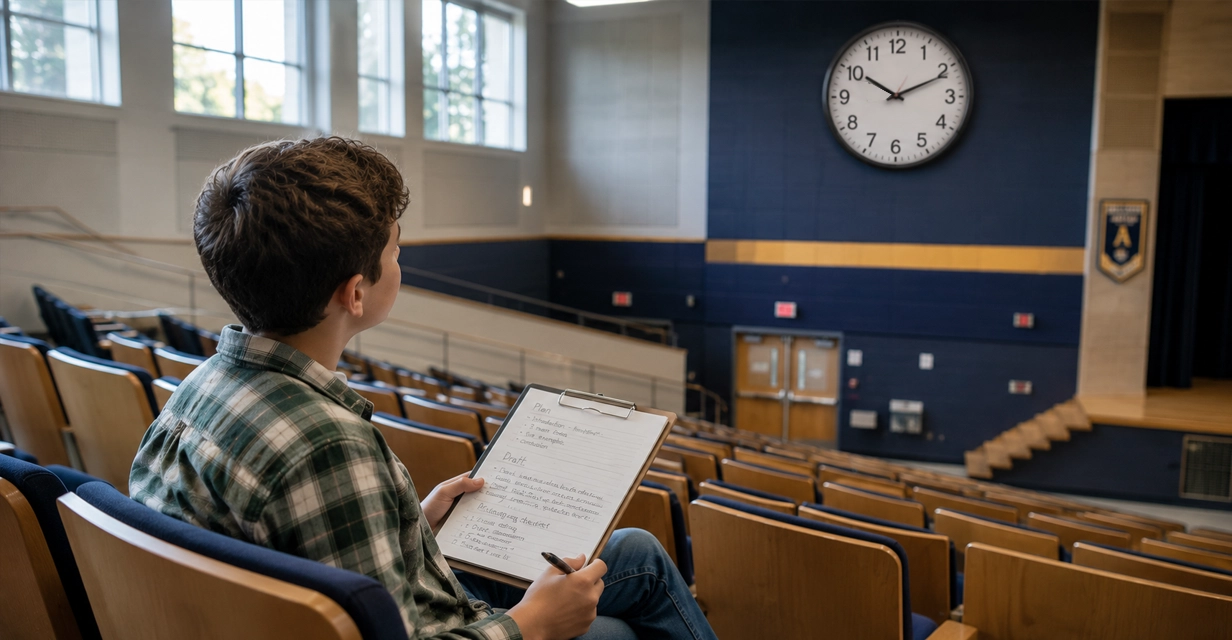
Planning at the start lifts two of the biggest levers at once. A quick plan locks in relevance, by deciding how the piece answers the prompt, and structure, by sketching a beginning, middle and end. A child who plans writes with direction, while one who plunges straight in often wanders and loses both.
Editing at the end recovers easy marks. A short read through to fix obvious spelling, grammar and punctuation slips, and to confirm the piece still answers the prompt, reclaims marks that would otherwise be lost. Most children skip this step entirely, which is exactly why it offers such a reliable advantage. Spending the 25 minutes this way turns a rushed scramble into a controlled, higher scoring performance.
The First Two Minutes: Planning for a Higher Mark
The first two to three minutes are the highest value moments of the whole task, because a quick plan raises both relevance and structure before a single sentence is written. Teaching your child to plan well is one of the most effective ways to lift their score.
The plan does not need to be elaborate. In those few minutes, your child should decide how they will respond to the prompt, choose one or two main ideas to develop, and jot a simple shape: how the piece begins, what happens in the middle, and how it ends. A few quick notes are enough.
This short investment pays off in several ways. It anchors the writing firmly to the prompt, protecting against the off topic trap. It gives the piece a clear structure, which markers reward directly. And it frees the child to write smoothly, because they already know where they are going rather than inventing the next idea mid sentence.
Encourage your child to resist the urge to start writing immediately. Under pressure, planning feels like wasted time, but it is the opposite, since a planned piece is almost always more relevant, better organised and less likely to stall halfway through. Two or three calm minutes at the start sets up a higher mark for everything that follows.
Writing for Depth, Not Length
To score higher, your child should aim for depth rather than length, because markers reward thoughtful, well developed ideas far more than a large quantity of shallow ones. A focused, detailed piece beats a long, rambling one almost every time.
Many children assume that writing more means scoring more, so they race to fill the page with as many ideas as possible. The result is often a thin piece that touches many things and develops none. The ASET rewards the opposite: a child who takes one or two ideas and explores them with genuine detail and originality.
Help your child slow their thinking, not their pen. Encourage them to ask what makes their idea interesting, surprising or vivid, and to add the detail that brings it to life, rather than jumping to a new point. Developing an idea fully is what demonstrates the thoughtfulness markers are looking for.
This also keeps the writing manageable in the time available. Trying to cram in too much leads to a rushed, unfinished piece, while focusing on a couple of well developed ideas leaves room to write clearly and to reach a proper ending. Depth over length is not only better for the mark, it is more achievable in 25 minutes, which makes it one of the most practical ways to score higher.
The Last Two Minutes: Easy Marks in the Edit
The final two to three minutes spent editing are some of the easiest marks your child can earn, because a quick review fixes errors that would otherwise cost them. Editing is a simple habit that most children skip, which makes it a reliable advantage.
In those last minutes, your child should read back over their writing with two jobs in mind. First, fix the obvious mechanics: misspelled words, missing full stops, capital letters and clumsy sentences. These corrections recover marks for accuracy that are otherwise simply given away.

Second, check the piece still clearly answers the prompt. A quick confirmation that the writing has stayed on topic from beginning to end guards against any late drift, protecting the most important lever of all right at the finish.
The reason this works so well is that almost no child does it. Under time pressure, most write until the clock runs out and never look back, leaving easy errors uncorrected. A child trained to save a short editing window arrives with a cleaner, more accurate piece than peers of similar ability. Pacing the writing to finish with a couple of minutes to spare, then using them to edit, is one of the simplest and most dependable ways to lift an ASET writing mark.
ASET Writing Practice That Builds Real Scores
The practice that genuinely lifts ASET writing scores is regular work on varied prompts, with the 25 minute routine rehearsed and specific feedback given. Effective GATE writing preparation in WA builds real, flexible skill rather than a single memorised piece.
Practise with a wide range of prompts, because the real prompt is unpredictable. Giving your child different pictures, phrases and statements to respond to builds the flexible thinking the task rewards and removes the temptation to rely on a rehearsed story. Each new prompt strengthens their ability to plan and respond quickly.
Rehearse the 25 minute routine until it feels automatic. Practising the plan, write and edit breakdown under a gentle time limit means that on the day, your child knows exactly how to spend each minute, which frees their attention for the writing itself. The routine becomes a calm habit rather than a panic.
Feedback is where writing improves fastest, and it is the hardest part to do alone. A child can write many pieces without progressing if no one shows them how to develop an idea more fully or shape a clearer ending. Reading the official guidance to understand what markers reward, and giving specific feedback on one or two things at a time, makes a real difference. This is also where expert support helps most, since targeted writing feedback from an experienced tutor can lift a child’s score in a way solo practice rarely matches. You may also find our guide on ASET reading comprehension strategies that work and how to prepare for GATE at home useful as you build out a full preparation plan.
Ready to get started?
Experience a full week of
GATE WA tutoring at no cost.
Conclusion
Scoring higher in ASET writing is not about luck or natural flair, but about making a few high leverage moves count within the 25 minutes. The marks concentrate around relevance, depth of ideas and clear structure, so a child who answers the prompt clearly, develops one or two ideas well, and shapes a strong beginning, middle and end is already most of the way there.
The two moves that lift a mark the most are the ones children skip: planning at the start, which locks in relevance and structure, and editing at the end, which recovers easy accuracy marks. Aim for depth rather than length, and the writing becomes both stronger and more achievable in the time available.
Build these habits through regular practice on varied prompts, rehearse the 25 minute routine, and seek specific feedback where you can. Do that, and your child walks into the ASET able to turn a blank page into a focused, relevant, well shaped piece, and to earn the full quarter of the score that writing is worth.
Want hands on support building these habits? Explore our Perth Modern School entry requirements explained guide, or get in touch today for a free consultation to see how Champion Tutors can support your child’s GATE WA journey.
Helpful Links for Parents
Gifted and Talented Secondary Selective Entrance programs, including official tips for the ASET writing task, WA Department of Education
https://www.education.wa.edu.au/giftedandtalented
Apply for Gifted and Talented Secondary Selective Entrance programs, WA Government
https://www.wa.gov.au/service/education-and-training/school-education/apply-gifted-and-talented-secondary-selective-entrance-programs
Australian Council for Educational Research (ACER), the body that develops and administers the ASET
https://www.acer.org
Resources Used
WA Department of Education, Gifted and Talented programs ASET writing task guidance, including timing, marking principles and the relevance requirement.
Australian Council for Educational Research (ACER), ASET structure and section timing.
Published WA GATE and ASET writing preparation guidance, including planning and editing strategy, 2026.