Currently Empty: $0.00
Dr. Arti Verma
- June 9, 2026
- Comment 0
Can You Prepare for the
GATE Test at Home?
Table of Contents
- Introduction
- Can You Prepare for the GATE Test at Home? The Short Answer
- The Free GATE Practice Materials Every Parent Should Use
- How to Prepare for GATE at Home, Section by Section
- Building a Home GATE Study Routine That Works
- The DIY GATE Practice Mistake to Avoid: Skipping the Review
- Preparing for ASET Without a Tutor: Where It Gets Harder
- Home GATE Study Tips to Keep It Calm and Effective
- Conclusion
- Helpful Links for Parents
- Resources Used
Introduction
Plenty of parents in Perth look at the cost of GATE tutoring and quietly wonder whether they could simply do it themselves. Your child is capable, you have time and energy to help, and you would rather guide them at the kitchen table than hand the job to a centre. So the natural question becomes how to prepare for GATE at home, and whether it can really work.
The encouraging news is that it can. Home preparation is not a second best option for this particular test. With the right materials and a steady approach, a family can prepare a capable child for the ASET without paying for a single tutoring session.
What makes this possible is the nature of the test and the resources behind it. The most accurate practice material is free, the test rewards familiarity rather than secret techniques, and the most powerful preparation activities are things a parent can weave into everyday life anyway.
This guide shows you exactly how to do it. It covers the free official materials to use, how to prepare each of the four sections at home, how to build a routine that lasts, the biggest mistake to avoid, and the one area where preparing alone gets genuinely harder. By the end, you will have a clear, practical plan for GATE preparation at home. Before you start, if you are still deciding whether outside support is necessary at all, is GATE tutoring worth it gives you the honest answer. Visit Champion Tutors to see how we support both home preparers and families who choose structured classes.
Can You Prepare for the GATE Test at Home? The Short Answer
Yes, you can prepare for the GATE test at home, and for most capable children it can be just as effective as paid tutoring. The test measures reasoning and potential rather than crammable content, so the goal is familiarisation and confidence, which a supportive family can absolutely provide.
This is not wishful thinking. The WA Department of Education, which runs the test, states plainly that coaching is not necessary and that paid services hold no advantage over the free official materials it provides. The most accurate preparation in the state is available to every family at no cost.
It helps to remember what the ASET actually rewards. Because it tests how a child thinks rather than what they have memorised, preparation is mostly about removing the disadvantage of unfamiliarity, building speed, and growing confidence across the four sections. None of that requires a tutor to deliver. If you are still weighing up options, is GATE tutoring worth it looks at this question from the other side.
The activities that move the score most are also home friendly by nature. Wide reading, regular reasoning practice, talking about ideas, and timed practice with official papers are all things a parent can build into ordinary life, often more consistently than a weekly class allows.
So the real question is not whether home preparation can work, because it can, but how to do it well. The rest of this guide is the practical answer, beginning with the materials every parent should know about. To understand what each of the four sections asks of your child before you start, understanding the ASET exam format is worth reading first.
The Free GATE Practice Materials Every Parent Should Use
The most important free GATE practice materials come straight from the WA Department of Education, and every family preparing at home should start there. They are the most accurate reflection of the real test available anywhere, paid or free.
The Department provides a full length practice ASET, an ASET handbook that explains each of the four sections in detail, and printable answer booklets like those used on test day. These become available from October each year on the official Gifted and Talented pages, and they cost nothing.
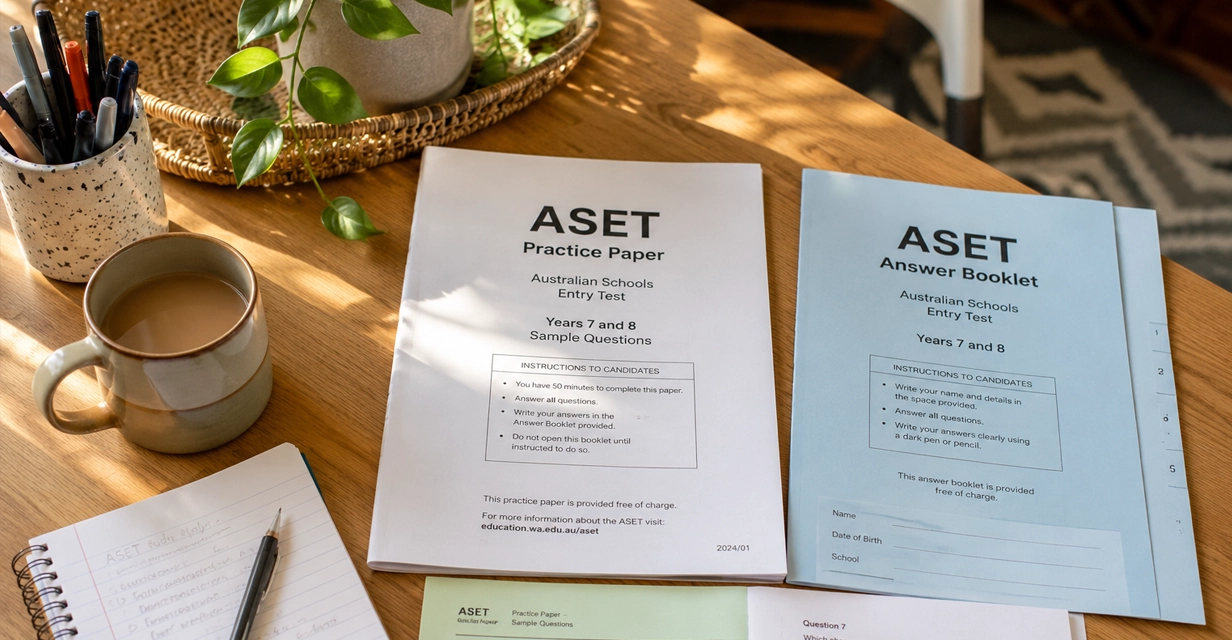
Their value lies in accuracy. Many paid resources only approximate the test, but the official practice ASET mirrors the genuine structure, difficulty and layout, so your child practises exactly what they will face. The handbook also helps you, as the parent, understand precisely what each section asks, and our guide to the ASET exam format can help you make sense of it alongside the official documents.
There is one limitation to plan around. Because only a small amount of official material exists, you will want to use it carefully rather than burn through it early. A sensible approach is to save the full practice ASET for later in your preparation, once your child knows the sections, so it works as a realistic trial run rather than a first encounter. Our guide on free and paid GATE practice tests with a step-by-step mock plan helps you decide exactly when and how to use each resource across your timeline.
Beyond the official papers, free reasoning puzzles, wide reading and everyday maths and writing practice round out a home program at no cost. You can also download our own free sample papers to give your child additional practice at the right level. Start with the Department’s materials as your anchor, and build the rest of your free GATE practice at home around them.
Ready to get started?
Experience a full week of
GATE WA tutoring at no cost.

How to Prepare for GATE at Home, Section by Section
Preparing for GATE at home works best when you tackle the four sections separately, because each rewards a different kind of practice. A simple, section by section approach makes the whole task manageable for any parent.
For reading comprehension, wide reading is your most powerful tool. Encourage your child to read across many text types, fiction, poetry, factual articles and more, then talk about what they read, asking what the writer meant and what evidence supports each point. This builds the inference and evidence finding skills the section depends on, and it costs nothing.
For quantitative reasoning, focus on problem selection rather than harder sums. Give your child word problems and ask them to work out which operation is needed before solving it, and practise quick mental maths without a calculator. The section rewards deciding what to do, not difficult calculation, so train that decision. If your child’s maths confidence is shaky, how to help your child with maths homework gives practical strategies to build that foundation at home first.
For abstract reasoning, the priority is familiarity, because most children never meet these puzzles at school. Work through pattern questions, sequences, matrices and odd one out problems, and teach your child to look for changes in shape, number, size, shading, position and rotation. Free reasoning puzzles online provide plenty of practice material here. For a deep explanation of exactly what this section involves, inside the ASET abstract reasoning section is essential reading. Our guide on the ASET abstract reasoning section goes into this in more detail.
For writing, practise responding to varied prompts under a gentle time limit, using a simple plan, write and edit routine. Remind your child that the writing must clearly answer the prompt, since relevance matters most, and aim for thoughtful ideas with a clear beginning, middle and end. See the ASET writing task explained for a closer look at what is expected. Covering all four sections this way gives your home program genuine breadth.
Building a Home GATE Study Routine That Works
A home GATE study routine works best when it is short, regular and built into a fixed time, so preparation becomes a calm habit rather than a daily battle. Consistency over months matters far more than long, occasional sessions.
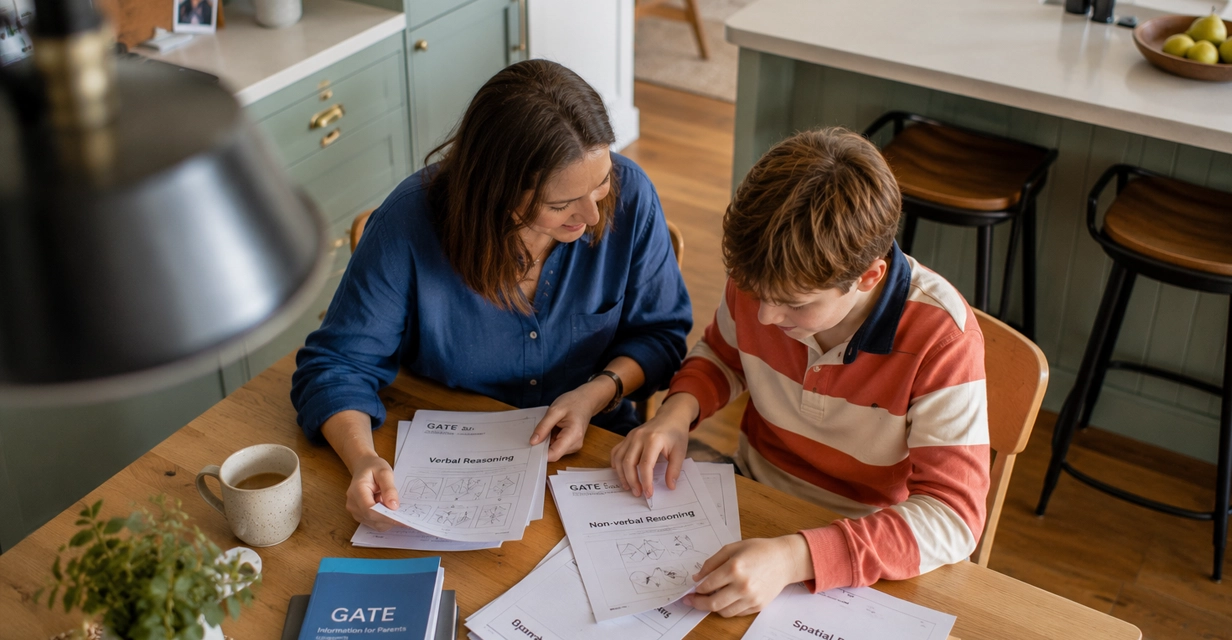
Aim for little and often. Three to five short sessions a week, each around 30 to 50 minutes, achieve far more than one tiring weekend marathon, because the reasoning skills the test rewards build through spaced, repeated practice. Shorter sessions also keep a Year 6 child fresh and willing.

Anchor the session to a regular slot. A child who knows that practice happens, for example, after afternoon tea on set days, settles into it more easily than one facing a fresh negotiation each time. A predictable rhythm removes resistance and protects family harmony. The strategies in how to end homework battles with your child apply just as usefully to GATE practice sessions as to school homework when it comes to building that calm routine.
Rotate the sections across the week so practice stays varied and no area is neglected. A session might pair a short block of reasoning questions with a few minutes reviewing the errors, while another focuses on reading or writing. Mixing things up mirrors the real test and keeps a child engaged.
Start early and keep it gentle. Beginning preparation around six months before the test lets the daily load stay light, with no need to cram. For families across the southern suburbs juggling school, sport and busy weeks, that early, modest routine is also the realistic one, since it fits around life rather than overwhelming it. Our GATE WA 2027 preparation tips for parents gives a month-by-month timeline for exactly this kind of steady, early start. If you are unsure how much is enough, how much GATE preparation your child needs sets out a clearer benchmark.
The DIY GATE Practice Mistake to Avoid: Skipping the Review
The biggest mistake in DIY GATE practice is doing question after question without reviewing the errors, which turns valuable practice into wasted time. The learning lives in the review, not in the volume of questions completed.
It is an easy trap to fall into. Finishing a page of questions feels productive, and it is tempting to simply mark them right or wrong and move on. But a child who never examines why they got something wrong repeats the same mistake next time, so the practice produces little real improvement.
The fix is simple and powerful. After each set of questions, sit with your child and work through the errors together, asking what rule they missed in an abstract reasoning question, or what the quantitative question was really asking. Understanding the mistake is what prevents it from happening again.
Quality beats quantity as a result. A child who carefully reviews 15 questions usually learns more than one who races through 50 and reviews none. This is why a calm, thoughtful pace at home can match or beat a busy class that never pauses to unpick errors.
This single habit is the heart of effective home preparation. Build review into every session, treat wrong answers as the most useful part rather than something to rush past, and your DIY practice becomes genuinely effective rather than merely busy. Our About Us page explains how this same review-centred approach is built into every session at our centres.
Preparing for ASET Without a Tutor: Where It Gets Harder
Preparing for the ASET without a tutor is very doable, but the writing section is the one area where going alone gets genuinely harder, because it needs expert feedback to improve. Knowing this lets you plan around the gap rather than be caught out by it.
The first three sections suit home practice well. Reading, quantitative reasoning and abstract reasoning all have clear right and wrong answers, so a parent with the official materials can set practice, check answers and review errors effectively. There is no real disadvantage to doing these at home.
Writing is different. A child can write many pieces and still not improve if no one shows them how to develop an idea more fully or structure a response more clearly. Without informed feedback, writing practice often stalls, and this is the part most parents find hardest to guide alone. If your child is a strong talker but a reluctant writer, why your child hates writing but loves talking explains precisely why that gap exists and what it takes to close it, which is directly relevant to the ASET writing task.
There are practical workarounds, though. Read the official handbook and any marking guidance so you understand what assessors look for, then give your child specific, useful feedback on one or two things at a time, such as answering the prompt clearly or finishing with a proper ending. Reading strong writing together also builds a child’s sense of what good looks like.
This is also the point where some families choose a little outside help, not because home preparation has failed, but because expert writing feedback is genuinely valuable. A few targeted sessions, or simply learning the criteria yourself, can close the one gap that home practice leaves, while the rest of the preparation stays comfortably at the kitchen table. Families in Canning Vale, Harrisdale and nearby suburbs can access writing feedback sessions at our local centres as a standalone option.
Ready to get started?
Experience a full week of
GATE WA tutoring at no cost.
Home GATE Study Tips to Keep It Calm and Effective
The best home GATE study tips all serve one aim: keeping preparation calm, consistent and genuinely useful, so your child improves without stress. A few simple principles make the whole journey smoother for everyone.
Keep it positive. Frame the puzzles as games and challenges rather than tests, celebrate the moment a tricky concept clicks, and avoid turning practice into pressure. A child who enjoys the work engages far better, and a relaxed child performs closer to their true ability on the day.
Protect rest and balance. More is not always better, and beyond a sensible daily amount a young child simply tires, so guard weekends, hobbies and downtime as essential rather than optional. A rested, happy child learns and tests better than an exhausted one.
Introduce timing gradually. Let your child work without a clock at first so they can focus on understanding, then slowly add time pressure until they are comfortable at the real pace. Saving full, timed practice with the official paper for later builds speed without breeding anxiety early on.
Stay involved without hovering. Sitting alongside a young child during review, then stepping back to let them work, builds independence and confidence together. Watch how your child is feeling as much as how they are scoring, and ease off if practice starts to cause stress. Calm, steady support is what makes home preparation both effective and kind. If you are weighing the cost of adding any class-based support alongside home preparation, primary tutoring cost in Perth gives honest 2026 price comparisons for every format.
Conclusion
You absolutely can prepare for the GATE test at home, and for most capable children it can work just as well as paid tutoring. The test rewards familiarity and confidence rather than crammable content, the most accurate practice materials are free from the WA Department of Education, and the activities that matter most suit family life beautifully.
The plan is straightforward. Use the official materials as your anchor, prepare each section in the way it rewards, build a short and regular routine, and above all review every mistake, since that is where the real learning happens. Start early, keep it gentle, and protect your child’s wellbeing throughout.
The one area to plan around is writing, where expert feedback is hardest to provide alone, though understanding the criteria and giving focused feedback goes a long way. Beyond that, a supportive parent and a steady routine are more than enough. Prepare calmly at home, and your child can walk into the ASET familiar, confident and ready to show their genuine potential.
Get in touch today for a free consultation if you would like a hand with any part of the journey, including the writing section.
Helpful Links for Parents
Gifted and Talented Secondary Selective Entrance programs, including the free official ASET practice paper and handbook, WA Department of Education
https://www.education.wa.edu.au/giftedandtalented
Australian Council for Educational Research (ACER), the body that develops and administers the ASET
https://www.acer.org
Apply for Gifted and Talented Secondary Selective Entrance programs, WA Government
https://www.wa.gov.au/service/education-and-training/school-education/apply-gifted-and-talented-secondary-selective-entrance-programs
Resources Used
WA Department of Education, Gifted and Talented Secondary Selective Entrance programs, free official ASET practice materials, handbook and preparation guidance.
Australian Council for Educational Research (ACER), ASET structure and the four assessed sections.
Published WA GATE and ASET home preparation guidance, including section by section practice and timing, 2026.