Currently Empty: $0.00

Dr. Arti Verma
- May 22, 2026
- Comment 0
Why Your Child Hates Writing but Loves Talking:
The Gap English Tutoring Is Designed to Close
Your child never stops talking. At dinner, in the car, at bedtime when they are supposed to be asleep, the words come easily. They tell stories with detail and drama. They argue a point confidently. They describe what happened at school with a cast of characters and a plot that would hold an audience.
Then you ask them to write a paragraph about their weekend, and they stare at the page for eleven minutes and produce three sentences.
If you have experienced this, you are not imagining the gap. It is real, it is specific, and it has a name. It is the spoken-written gap, and it is one of the most common and least understood challenges in primary and early secondary school English.
Most parents assume that a child who speaks well should also write well. This feels logical. If they have the words, surely the words should make it onto the page. But speaking and writing are not the same skill. They draw on different cognitive processes, they develop at different rates, and a child can be genuinely strong in one while struggling significantly in the other.
This guide explains exactly why the gap exists, what it looks like in everyday school English, why it matters for NAPLAN and the broader WA curriculum, and what targeted English tutoring does to close it in a way that actually lasts.
Table of Contents
- Why Speaking and Writing Are Not the Same Skill
- What Creates the Spoken-Written Gap in Children
- What the Gap Looks Like at School and at Home
- Why the Gap Widens Over Time Without Intervention
- How NAPLAN Writing Exposes the Gap
- The Five Things English Tutoring Builds to Close the Gap
- What Parents Can Do at Home Alongside Tutoring
- How We Work with Students at Champion Tutors
- What to Do if You Recognise Your Child in This Guide
- Conclusion
- Helpful Links for Parents
- Resources Used
Why Speaking and Writing Are Not the Same Skill
This is the foundation of everything that follows, and it is the insight that most parents find genuinely surprising.
When a child speaks, the conditions are supportive in ways we rarely notice. There is a listener who provides real-time feedback through facial expressions and responses. The speaker can adjust as they go, adding detail, backtracking, rephrasing if something comes out wrong. The pace is self-determined. The vocabulary can be approximate because tone of voice, gesture, and context fill the gaps. And perhaps most importantly, there is no permanent record. A spoken sentence that does not quite work simply disappears.
When a child writes, none of these conditions exist. There is no listener to orient toward. There is no immediate feedback to guide adjustments. The pace is fixed by the mechanics of holding a pencil or typing. The vocabulary must be precise because there is no tone of voice to add meaning. Every sentence is permanent and visible, sitting on the page to be read and judged. And the entire thing must be planned, organised, and executed simultaneously, with no one to help carry the weight of it.
These are not minor differences. They are fundamental ones. Writing is a far more cognitively demanding task than speaking, not because writing requires more intelligence, but because it requires the management of far more processes at the same time. A child who speaks easily has demonstrated they have ideas, vocabulary, and the ability to sequence thought. They have not demonstrated that they can do all of these things simultaneously while also managing handwriting, spelling, punctuation, structure, and the absence of a supportive listener.
The unique insight that most English tutoring guides miss is this: verbal fluency can actively mask written weakness for years, because it creates the impression that the language ability is present. It is present, but in a form that does not yet transfer to writing. The transfer is the skill that needs to be taught.
What Creates the Spoken-Written Gap in Children
The spoken-written gap is not a mystery. It has specific causes, and understanding them helps parents see the gap more clearly in their own child.
Writing Has Not Been Modelled as a Process
Speaking develops naturally through immersion. From birth, a child is surrounded by spoken language, absorbs it, and begins to produce it without explicit instruction. Writing does not develop this way. It requires explicit teaching of a process: how to generate an idea, how to organise it, how to translate it into sentences, how to construct those sentences in a way that communicates on the page what the spoken version would communicate in person.
Many children receive instruction in the mechanics of writing, spelling, punctuation, and handwriting, without receiving clear instruction in the process of writing. They know how to form letters, but they have never been walked through how to get from a thought to a paragraph in a way that feels manageable.
The Transition From Informal to Formal Register Has Not Happened
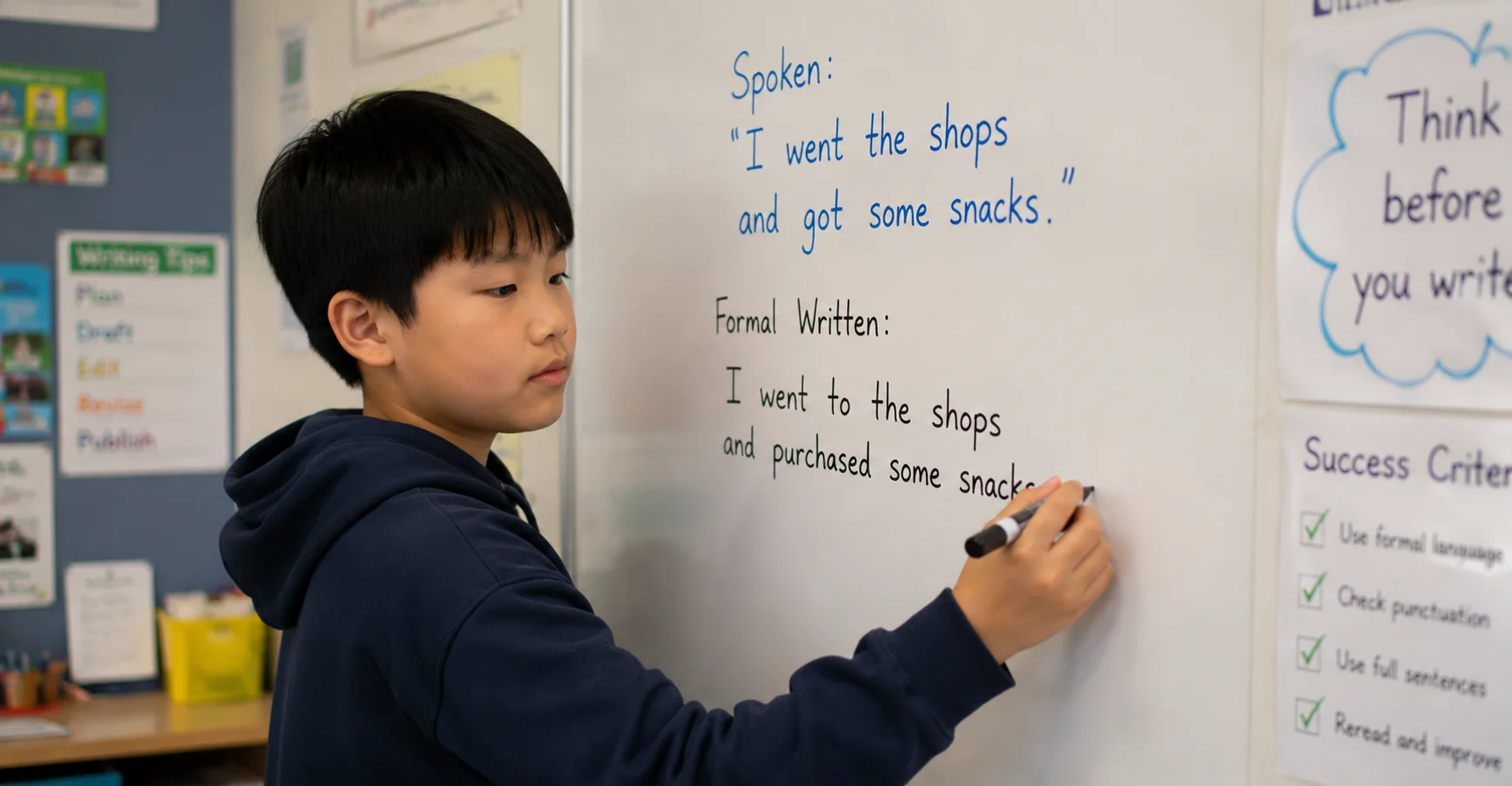
Spoken language in children is informal. It uses casual vocabulary, incomplete sentences, filler words, and a structure that flows naturally from one idea to the next without needing to be planned. School writing requires a more formal register: complete sentences, organised paragraphs, appropriate vocabulary, and a structure that is planned rather than emergent.
Many children who speak fluently have never made the conscious shift from informal spoken register to formal written register. They attempt to write the way they speak, and the result is a written piece that lacks the structure, precision, and formality that school English requires. It reads as thin, casual, and underdeveloped, even when the ideas behind it are sound.
Spelling and Punctuation Anxiety Blocks Flow
For some children, the knowledge that spelling and punctuation will be assessed creates a kind of paralysis. They choose simple words they know they can spell rather than the more precise words they would choose if spelling were not a concern. They write shorter sentences to reduce the risk of punctuation errors. They produce writing that is technically safer but intellectually less ambitious than their spoken language, because they are making decisions based on what they can defend rather than what they actually want to say.
This is a particularly painful dynamic because it means the child’s anxiety about mechanics is actively suppressing the expression of their genuine thinking.
The Physical Act of Writing Creates Cognitive Overload
Writing requires a child to simultaneously manage ideas, vocabulary, sentence structure, handwriting or typing, spelling, punctuation, and the overall organisation of the piece. For many children, particularly in primary school, the physical demands of writing absorb so much cognitive capacity that there is very little left for the higher-order work of organising and expressing ideas.
A child who speaks with confidence and detail may produce thin written work simply because the mechanics of the writing task are consuming the mental resources that the ideas would otherwise occupy.
What the Gap Looks Like at School and at Home
Once you know what the spoken-written gap is, you begin to see it in specific and recognisable ways.
At home, it shows up most clearly at homework time. Your child can tell you exactly what they think about the book they read, but the written response they submit contains one-fifth of the thinking. They spend twenty minutes staring at the page, produce four sentences, and seem genuinely relieved when it is over. When you point out that they know far more than what they have written, they say “I know, but I do not know how to write it.”
That phrase, “I do not know how to write it,” is one of the most important things a child can tell you about their relationship with writing. It is honest and accurate. They do know it. They just do not yet know how to transfer it.
At school, the gap shows up in written English tasks that consistently come back with teacher feedback such as “ideas need more development,” “please expand on this point,” or “your response lacks detail.” These comments appear on work produced by a child who, in class discussion, contributed thoughtfully and at length. The teacher has seen both sides of the gap without necessarily naming it.
In creative writing tasks, the gap often produces work that is technically correct but emotionally flat. The child has managed the mechanics but has not been able to layer in the detail, the voice, and the specificity that their spoken version of the same story would carry.
In structured writing tasks such as essays and explanations, the gap produces responses that cover the required points briefly and without elaboration, rather than developing each idea with the depth and evidence the task requires.
Why the Gap Widens Over Time Without Intervention
The spoken-written gap does not stay the same size if it is left unaddressed. It widens, and it does so for a specific and understandable reason.
Speaking improves naturally and continuously through everyday use. A child who speaks regularly in a variety of contexts, at home, at school, with friends, in activities, is practising and developing their spoken language constantly. Their vocabulary grows, their ability to structure an argument or a narrative improves, and their confidence in expressing ideas increases.
Writing, on the other hand, improves only through deliberate practice. A child who avoids writing, or who practises it reluctantly and minimally, does not improve. And because the gap between spoken and written performance is frustrating and unrewarding, many children with the spoken-written gap instinctively do less writing, which means the gap widens further.
By the time a child reaches Year 7 or Year 8, the spoken-written gap that began in Year 4 or Year 5 as a noticeable but manageable difference can have become a significant barrier. Secondary school English is heavily weighted toward written performance. Essays, analytical responses, creative pieces, and exam answers are all written. A child who arrives at secondary school with an underdeveloped ability to transfer their thinking into writing will find English progressively more difficult, even if they continue to be verbally confident and articulate.
The earlier the gap is addressed, the smaller the intervention required. A child in Year 4 or Year 5 with a moderate spoken-written gap typically closes it within two to three school terms of targeted English tutoring. A child in Year 8 with a well-established gap requires longer and more intensive support.
How NAPLAN Writing Exposes the Gap
NAPLAN is administered in Years 3, 5, 7, and 9 in Western Australia. The writing component places a child with the spoken-written gap under conditions that expose it very clearly.
The NAPLAN writing task is timed, unassisted, and assessed on specific criteria: ideas and content, text structure, character and setting where relevant, vocabulary, cohesion, paragraphing, sentence structure, punctuation, and spelling. These criteria collectively require a child to do in writing what they can do in speech, but under time pressure, without a conversational partner, and to a standard that is assessed against year-level expectations.
A child with the spoken-written gap tends to produce NAPLAN writing that scores well on spelling and punctuation, because these are the mechanics they have prioritised, and poorly on ideas, vocabulary, and cohesion, because these are the areas where the gap between their thinking and their written expression is most visible.
The vocabulary criterion in particular is revealing. NAPLAN writing assessors look for precise, varied, and appropriate word choice. A child who uses words like “good,” “nice,” “bad,” and “went” in their NAPLAN response is producing writing that reflects the informal register of their spoken language rather than the precise and varied vocabulary that NAPLAN rewards. Their spoken vocabulary may include words like “remarkable,” “reluctant,” “ventured,” and “devastated,” but those words have not yet made the crossing into their written work.
Beyond NAPLAN, the WA English curriculum from Year 4 onward places increasing demands on written expression. By Year 5, students are expected to construct cohesive, multi-paragraph written responses with a clear structure, varied vocabulary, and ideas developed with detail and evidence. By Year 7, extended analytical and creative writing is a core part of the assessment programme. These expectations assume that the spoken-written gap has been closed. For a child in whom it has not, these year levels bring increasing frustration and underperformance. Learn more about our NAPLAN tutoring service.
Ready to get started?
Experience a full week of
English tutoring at no cost.

The Five Things English Tutoring Builds to Close the Gap
The spoken-written gap is a skills gap, not an intelligence gap and not a creativity gap. The skills it requires are teachable, and they are the specific focus of targeted English tutoring.
Planning and Pre-Writing
Most children who struggle with writing try to generate ideas and write simultaneously. This is cognitively overwhelming. Skilled writers plan before they write. They know what they are going to say, in what order, and roughly how they are going to say it, before they write the first sentence.
English tutoring teaches planning as an explicit, structured skill. Students learn to brainstorm ideas separately from the task of writing them. They learn to organise those ideas into a sequence before committing to sentences. They learn that a few minutes of planning produces writing that is richer, better organised, and easier to produce than writing generated without a plan.
This single skill change produces visible improvement in written output very quickly.
Formal Written Register
Moving from informal spoken language to formal written language is a learnable transition. English tutoring explicitly teaches students what formal writing looks and sounds like, how it differs from speech, and how to make choices in vocabulary and sentence structure that produce writing that reads with the appropriate level of formality and precision.
Students practise this transition in guided writing tasks, where they take ideas they have expressed verbally and work through the process of expressing them in writing with appropriate vocabulary, sentence structure, and organisation. The repeated movement between spoken and written versions of the same content makes the transition increasingly automatic over time.
Vocabulary for Writing
Vocabulary development in English tutoring for the spoken-written gap is not about learning lists of impressive words. It is about developing the habit of reaching for precise words in writing, the same words a student might use in speech, and building confidence in spelling and using those words correctly on the page.
Students work with rich vocabulary in context, encountering words in what they read, discussing their meanings and shades of difference, and using them in their own writing. Over time, the vocabulary range available in their written work approaches and then matches the range they use when they speak.
Sentence Variety and Cohesion
A child who speaks confidently tends to vary the length and structure of their sentences naturally, because conversation has a rhythm that creates variety automatically. In writing, that natural rhythm is absent, and many children default to a series of short, similarly structured sentences that make their writing feel flat and disconnected.
English tutoring teaches sentence variety and cohesion explicitly: how to combine ideas across sentences, how to use different sentence structures for different effects, and how to use connectives and transitions to produce writing that flows in the way their spoken language does.
Writing Stamina and Confidence
Perhaps the most important thing English tutoring builds is the experience of writing successfully. A child who has experienced writing as consistently frustrating and unrewarding has developed a negative relationship with it. They sit down to write expecting it to be hard, and that expectation shapes their performance.
Targeted English tutoring provides structured, supported writing experiences in which success is built in. Students produce writing they are genuinely proud of. They receive feedback that is specific, actionable, and encouraging. They develop the experience of writing as something that is challenging but achievable, and that shift in relationship with the task is what allows confidence to grow alongside skill.

What Parents Can Do at Home Alongside Tutoring
There are specific things parents can do at home that genuinely accelerate the progress English tutoring makes with the spoken-written gap. These are not about adding pressure or extra work. They are about creating conditions that support the transfer from spoken to written language.
Narrate before writing. When your child has a writing task, ask them to tell you what they are going to write before they write it. Listen to their spoken version, notice the detail and vocabulary they use, and then gently ask them to try to get as much of that into the written version as they can. This bridges the spoken and written versions explicitly.
Read writing aloud together. Read good writing aloud with your child, not just books, but newspaper articles, descriptions, well-crafted sentences from wherever you encounter them. Hearing precise, varied, and expressive written language builds familiarity with the register that writing requires.
Ask for the word behind the word. When your child says something vague in conversation, such as “it was really good” or “the character was bad,” ask them gently what word could replace “good” or “bad” that would be more specific. Make this a game rather than a correction. The habit of reaching for the precise word in speech transfers to writing over time.
Celebrate written effort, not just written product. Notice and name the specific things your child does well in their writing, the word they chose, the detail they included, the sentence that worked. Positive feedback on specific writing choices builds the confidence that the spoken-written gap has often eroded.
How We Work with Students at Champion Tutors
At Champion Tutors, we work with students across Years 3 to 9 at our five Perth centres in Canning Vale, Harrisdale, Piara Waters, Hammond Park, and Kwinana. The spoken-written gap is one of the most common challenges we see in students referred for English tutoring, and it is one we are specifically experienced in addressing.
Our approach begins with understanding the specific nature of each student’s gap. Not every child with the spoken-written gap has the same underlying challenge. Some have strong ideas but limited formal vocabulary. Some have good vocabulary but have never been taught to plan before writing. Some have excellent ideas and vocabulary but collapse under the cognitive load of managing mechanics and expression simultaneously. Identifying where specifically the gap sits allows us to direct tutoring where it will have the most immediate and lasting impact.
We work with students on planning as an explicit skill, on the transition between spoken and written register, on vocabulary development through reading and guided writing, on sentence variety and cohesion, and on building the writing stamina that comes from having experienced success rather than consistent struggle.
Each student receives personalised attention in small groups, and every piece of writing they produce receives specific, constructive, and encouraging feedback. Parents receive regular updates on their child’s progress so that the work happening in sessions can be reinforced and supported at home.
The progress students with the spoken-written gap make through targeted English tutoring is typically visible within eight to ten weeks. Parents notice it first at homework time: the staring at the page becomes shorter, the finished piece becomes longer and richer, and the relief at the end is gradually replaced by something closer to satisfaction.
If you would like to understand exactly where your child’s spoken-written gap sits and what closing it would look like in practice, you can book a free consultation with our team today.
Ready to get started?
Experience a full week of
English tutoring at no cost.
What to Do if You Recognise Your Child in This Guide
If your child speaks confidently and in detail but produces writing that does not reflect their thinking, the spoken-written gap is almost certainly present.
The first thing to do is observe it deliberately. For one week, pay attention to the difference between what your child says about a topic and what they write about the same topic. Notice the vocabulary difference, the detail difference, and the structural difference. If the spoken version is consistently and significantly richer, you have confirmed the gap.
The second thing to do is have a conversation with your child that is not about fixing the problem but about naming it. Tell them that you have noticed how well they speak and how much they know, and that you would like to help them get that same knowledge and those same words onto the page. Children who understand that the gap is a specific and fixable skill issue, rather than a sign that they are bad at English, respond very differently to support.
The third thing to do is explore targeted English tutoring. The spoken-written gap does not close through general improvement over time. It requires direct instruction in the specific skills that transfer spoken language competence into written expression. That is what English tutoring at Champion Tutors is built to provide. You may also find our guide on 7 quiet signs your child needs English tutoring helpful, as well as our explanation of the comprehension gap explained.
Conclusion
Your child is not short of words, ideas, or the ability to think clearly and communicate compellingly. The evidence for that is in every conversation you have had with them.
What they are short of is the specific set of skills that allows those words and ideas to make the crossing from speech to writing. That crossing is teachable. It is learnable. And for most children who receive targeted English tutoring focused on this specific gap, it closes in a timeframe that feels surprisingly short given how long the frustration has been present.
The talking is not the problem. The talking is actually the clearest evidence you have that the capacity is there. What is needed now is support that builds the bridge between the spoken version of your child’s thinking and the written version the world asks them to produce.
That bridge is what English tutoring is designed to build. Champion Tutors is here to help you build it.
Book a free consultation today to explore how we can support your child’s English journey.
Helpful Links for Parents
Western Australia Department of Education — English curriculum
https://www.education.wa.edu.au
ACARA — Australian Curriculum English overview
https://www.acara.edu.au
NAPLAN — Official writing assessment information for parents
https://www.nap.edu.au
Resources Used
Western Australia Department of Education — English curriculum
https://www.education.wa.edu.au
ACARA — Australian Curriculum English overview
https://www.acara.edu.au
NAPLAN — Official writing assessment information for parents
https://www.nap.edu.au