Currently Empty: $0.00

Dr. Arti Verma
- June 4, 2026
- Comment 0
How Many Hours of GATE Preparation
Does Your Child Actually Need
Table of Contents
- Introduction
- How Many GATE Preparation Hours Does Your Child Actually Need?
- Why Hours Are the Wrong Way to Measure GATE Preparation
- How Long to Prepare for GATE: Starting Early Beats Cramming
- How Much GATE Practice Is Enough? Finding the Healthy Balance
- Building a Daily GATE Practice Routine That Lasts
- A Simple ASET Study Plan and Preparation Schedule
- Signs Your Child Is Doing Too Much
- Conclusion
- Helpful Links for Parents
- Resources Used
Introduction
If you are a parent in Perth weighing up GATE preparation, you have probably asked yourself the same anxious question from both directions. Are we doing enough to give our child a fair chance, and are we quietly doing too much and risking their happiness along the way? It is one of the hardest balances for any family to strike.
The number that circulates online does not always help. Parents hear that families invest well over a hundred hours of GATE preparation, and immediately start counting, wondering whether their own child is falling behind some invisible quota. That mindset can turn a healthy preparation into a stressful race.
The reassuring truth is that the right amount of preparation is far gentler and more sustainable than the scary figures suggest. What matters is not the raw total of hours, but how steadily and how well those hours are used across a long enough runway. A calm habit beats a frantic sprint every time.
This guide answers the real question behind how many GATE preparation hours your child needs. It covers how long to prepare, how much practice is genuinely enough, how to build a routine that lasts, and the warning signs that your child is doing too much. Throughout, the goal is a confident, well prepared child who is also still a happy one.
How Many GATE Preparation Hours Does Your Child Actually Need?
Most children prepare well for the GATE test on around 40 to 50 minutes a day, or a few short sessions a week, spread across roughly six months. That works out to a manageable total, often cited as somewhere above a hundred hours, but the daily amount is small and sustainable rather than intense.
Experienced WA preparation guidance commonly points to families investing more than 168 hours over about six months. On paper that sounds enormous, but broken down it is gentle: a little under an hour a day, several days a week, for half a year. Framed that way, it sits comfortably alongside school, sport and family life rather than overwhelming them.
The exact figure your child needs depends on three things: where they are starting from, how much time you have before the test, and how the four sections suit them. A child who already reads widely and enjoys puzzles may need less, while a child meeting these question types for the first time may benefit from a little more.
The key is to read that hour total as a rough guide, not a target to chase. A child who does steady, focused practice over months will be far better prepared than one who logs the same hours in a panicked final fortnight.
So the honest answer is that your child needs enough regular, good quality practice to feel familiar and confident, which for most families is modest and entirely livable. Understanding why hours alone are a poor measure makes this even clearer.
Ready to get started?
Experience a full week of
GATE WA tutoring at no cost.

Why Hours Are the Wrong Way to Measure GATE Preparation
Hours are the wrong way to measure GATE preparation because the same number of hours can produce wildly different results depending on how they are spent. Quality and consistency matter far more than the total on the clock.
Consider two children who each do a hundred hours. One crams them into the six weeks before the test in long, tiring sessions, while the other spreads them across six calm months in short, regular blocks. The second child will almost always perform better, because the skills the ASET tests, reasoning and pattern recognition, build through spaced, repeated practice rather than through marathon study.
Review is the other thing an hour count hides. A child who works through fifty questions and never examines their mistakes learns far less than a child who does twenty questions and carefully understands every error. The valuable learning happens in the review, not in the volume, and no hour total captures that.
There is also the matter of where the hours go. Spending most of the time on a child’s strongest section feels productive but moves the score very little, while the same time spent lifting their weakest section, often abstract reasoning, which is rarely taught at school, can make a real difference.
Here is the insight that should ease the pressure. The question is not how many hours your child accumulates, but whether they practise consistently, review their mistakes, and focus on the right areas. A smaller number of well used hours beats a larger number of wasted ones, which means a healthy, sensible routine is also the most effective one.
How Long to Prepare for GATE: Starting Early Beats Cramming
The best answer to how long to prepare for GATE is to start around six to twelve months before the test, because a long, gentle runway always beats a short, intense one. Beginning early lets your child build skills slowly, without the pressure that harms both results and wellbeing.
Most children who prepare well begin structured practice six to twelve months ahead. Since the ASET is held in March, that means starting somewhere in the middle of the previous year. This generous window is precisely what allows the daily commitment to stay small, because there is no need to rush.
Starting early carries three quiet advantages. It lets skills develop progressively, so nothing has to be forced. It keeps the daily load light, protecting your child from stress. And it leaves room for life to happen, so a busy week, an illness or a holiday does not derail the whole plan.
Cramming does the opposite. Squeezing preparation into the final weeks demands long, exhausting sessions, raises anxiety just when calm matters most, and gives the brain no time to absorb the reasoning skills that develop gradually. A stressed, tired child rarely performs at their best.
For families across the southern suburbs juggling school runs, sport and weekend commitments, the early start is also the realistic one. Beginning in good time means your child can prepare in short, comfortable doses around everything else, rather than sacrificing their routine in a frantic final push. The earlier you begin, the gentler the whole journey becomes.
How Much GATE Practice Is Enough? Finding the Healthy Balance
Enough GATE practice is the amount that keeps your child improving steadily while still leaving plenty of room for rest, play and ordinary childhood. For most Year 6 children, that means short, regular sessions rather than long daily grinds, and it has a clear upper limit.
More is not always better, and past a certain point it becomes worse. A young child has limited focus and energy, so beyond around 40 to 50 minutes of concentrated practice in a day, attention fades and the extra time yields little. Pushing well beyond that risks fatigue, resistance and, over months, genuine burnout.
A healthy benchmark for most families is three to five short sessions a week, each lasting roughly half an hour to fifty minutes, depending on the child and the time remaining before the test. That rhythm is enough to build familiarity and confidence across all four sections without crowding out everything else a child needs.
Watch your child rather than the clock. A child who is engaged, making progress and still cheerful is doing the right amount, while one who is tearful, exhausted or dreading practice is doing too much, no matter how few hours that represents. Their response is the truest measure of balance.
Remember why the GATE pathway exists in the first place. It is meant to open opportunities for your child, not to consume their final year of primary school. The families who get this right protect weekends, hobbies and downtime fiercely, treating those as essential to performance rather than obstacles to it. A rested, happy child simply learns and tests better.
Building a Daily GATE Practice Routine That Lasts
A daily GATE practice routine that lasts is short, consistent and built into the day at a fixed time, so it becomes a calm habit rather than a daily negotiation. The aim is little and often, not long and occasional.
Anchor the session to a regular slot. A child who knows that practice happens, for example, for half an hour after afternoon tea, settles into it far more easily than one facing a different battle each day. A predictable, modest routine removes resistance and protects family harmony.
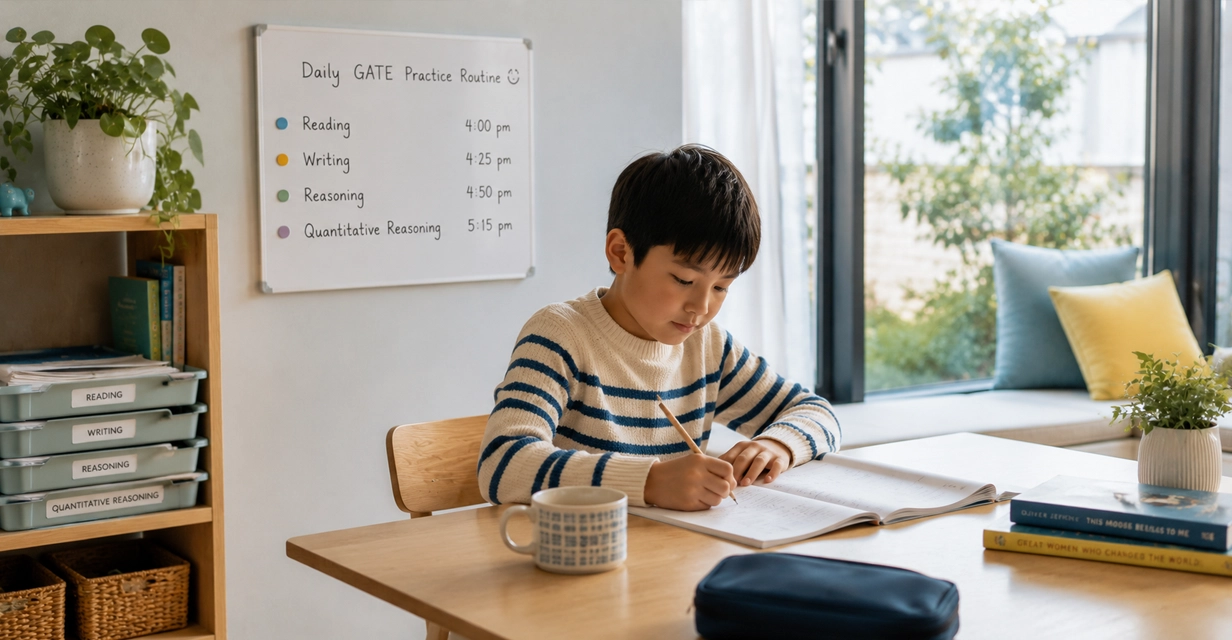
Keep each session focused and varied. A short block works best when it has a clear purpose, such as a set of reasoning questions followed by a few minutes reviewing the errors. Rotating through the four sections across the week keeps practice fresh and ensures no area is neglected, while preventing the boredom that comes from drilling one thing endlessly.
Protect quality over duration. It is far better for your child to do 30 focused minutes than 60 distracted ones, so end a session while attention is still good rather than pushing into tired, unproductive time. Stopping on a positive note also keeps a child willing to return tomorrow.
Build in rest without guilt. A genuine day off each week, and lighter weeks when life is busy, keep the routine sustainable across many months. Consistency over time matters far more than perfection on any single day. A tutoring centre experienced with the ASET can help shape a routine pitched at the right level for your child and keep the focus on reviewing mistakes, which is where a short daily routine delivers the most.
A Simple ASET Study Plan and Preparation Schedule
A simple ASET study plan spreads gentle preparation across about six months, moving from building skills, to timed practice, to calm consolidation. The schedule below keeps the daily load light while covering everything your child needs.
| Phase | Rough timing | Main focus | Typical load |
|---|---|---|---|
| Foundation | Months 1 to 2 | Assess all four sections, find the weakest, learn the question types, build a gentle routine | 30 to 45 minutes, a few days a week |
| Skill building | Months 3 to 4 | Strengthen each section in turn, prioritise the weakest, review every mistake | 40 to 50 minutes, most weekdays |
| Timed practice | Month 5 | Add time pressure, practise pacing, attempt a couple of full papers | 40 to 50 minutes, most weekdays |
| Consolidation | Final weeks | Light review, fix remaining gaps, build confidence, rest well before the test | Shorter, lighter sessions |
Start by finding the baseline. In the first phase, have your child try questions from each section so you can see where they are strong and where they struggle, then aim the rest of the plan at the areas that need it most, rather than spreading effort evenly.
Build the core skills next. Through the middle months, work section by section, giving extra attention to the weakest area and reviewing errors carefully, since this is where the real gains are made. Keep the daily amount modest and the rhythm steady.
Add timing only once skills are solid. Introducing the clock too early breeds anxiety, so save full, timed practice for the later phase, when your child already understands the questions and simply needs to build speed and stamina.
Finish gently. In the final weeks, ease back rather than ramp up, so your child arrives rested and confident rather than exhausted. A calm, well slept child on test day is worth more than any extra hour of last minute cramming.
Ready to get started?
Experience a full week of
GATE WA tutoring at no cost.
Signs Your Child Is Doing Too Much
The clearest signs your child is doing too much are emotional and physical rather than academic: dread, tears, tiredness or a fading love of learning. Recognising these early matters far more than any score, because a child’s wellbeing always comes first.
Watch for a change in feeling about practice. A child who once approached sessions willingly but now resists, complains or becomes upset is telling you the load is too heavy. Preparation should challenge a child, not distress them, and persistent dread is a signal to ease off, not to push harder.
Notice the physical signs too. Trouble sleeping, frequent headaches or stomach aches, unusual irritability, or seeming worn out can all reflect too much pressure. Young children often show stress in their bodies before they can put it into words, so these changes deserve attention.

Be alert to a loss of confidence as well. If your child begins describing themselves as not clever enough, or seems more anxious and less sure than before, the preparation may be doing harm rather than good. Healthy practice should build a child up, leaving them more confident, not less.
If you see these signs, scale back without hesitation. Shorten sessions, add more rest, lighten the week, and remind your child that this one test does not define them and that wonderful options exist across Perth whatever the result. A balanced, happy child not only feels better, but also walks into the test calmer and performs closer to their true ability.
Conclusion
The honest answer to how many GATE preparation hours your child needs is gentler than most parents fear. For the majority of children, around 40 to 50 minutes a day, or a few short sessions a week, spread across six months, is plenty. The exact hour total matters far less than the rhythm behind it.
What truly drives a strong result is consistency, careful review of mistakes, focus on the weakest section, and an early enough start to keep the daily load light. Cramming hurts both scores and children, while a calm habit over a long runway delivers the best of both: real preparation and a happy child.
Above all, keep watching your child rather than the clock. A learner who is engaged, improving and still cheerful is doing exactly the right amount, however many hours that adds up to. Prepare steadily, protect rest and play, and your child can walk into the ASET confident and ready, with their wellbeing and their love of learning fully intact.
Get in touch today for a free consultation to explore how we can support your child’s GATE WA journey.
Helpful Links for Parents
Gifted and Talented Secondary Selective Entrance programs, key dates and how the process works, WA Department of Education
https://www.education.wa.edu.au/giftedandtalented
Apply for Gifted and Talented Secondary Selective Entrance programs, WA Government
https://www.wa.gov.au/service/education-and-training/school-education/apply-gifted-and-talented-secondary-selective-entrance-programs
Australian Council for Educational Research (ACER), the body that develops and administers the ASET
https://www.acer.org
Resources Used
WA Department of Education, Gifted and Talented Secondary Selective Entrance programs and testing timeline.
Australian Council for Educational Research (ACER), ASET structure and section format.
Published WA GATE and ASET preparation guidance on recommended timelines and study hours, 2026.