Currently Empty: $0.00
Dr. Arti Verma
- June 7, 2026
- Comment 0
Group Classes or Private Tutoring for GATE:
Which Suits Your Child
Table of Contents
- Introduction
- What Are Your GATE Tutoring Options?
- Private vs Group GATE Tutoring: What the Evidence Says
- The Strengths of One on One GATE Tutoring
- The Strengths of Small Group GATE Classes
- Which Suits Your Child? Matching the Format to the Need
- The Best Way to Prepare for GATE: Why a Blend Often Wins
- Finding GATE Tutoring Near You in Perth
- Conclusion
- Helpful Links for Parents
- Resources Used
Introduction
When Perth families decide to prepare their child for the GATE test, one of the first questions they face is how. Should you book a private tutor who works with your child alone, or enrol them in a small group class with other students aiming for the same goal? Both are common, both can work, and the choice is not obvious.
It is easy to assume that one on one tutoring must simply be better, since it costs more and feels more personal. Yet the evidence on tutoring tells a more interesting story, and the right answer depends far more on your child than on any general rule about which format is superior.
Choosing well matters, because GATE preparation runs over many months and shapes how your child experiences the whole journey. The wrong format can leave a child bored, anxious or under supported, while the right one keeps them engaged, motivated and genuinely improving across all four sections of the test.
This guide compares your GATE tutoring options honestly. It looks at what the research says about private versus group tutoring, sets out the real strengths of each, helps you match the format to your child, and explains why a blend of both is often the smartest approach. The aim is a clear, balanced view so you can choose with confidence. Before diving in, if you are still working out whether your child should attempt GATE at all, our full explanation of the ASET exam questions answered for WA parents is a useful starting point. Visit Champion Tutors to learn how we support families through the GATE journey every year.
What Are Your GATE Tutoring Options?
Your main GATE tutoring options are one on one private tutoring, small group classes, or a combination of the two. Each delivers the same preparation for the ASET, the test that decides GATE entry, but in a very different setting and at a different cost.
One on one tutoring pairs your child with a single tutor who works with them alone. The entire session is built around that one child, which allows complete personalisation but also carries the highest hourly cost. It is the most individual of the options.
Small group classes place your child with a handful of other students, usually a few children working together under one tutor. The teaching is shared, the cost per child is lower, and the setting feels closer to a classroom, with the added ingredient of peers working toward the same goal. Our full guide on how small group tutoring works and why it beats a crowded classroom explains the research behind this format in depth.
A blended approach combines the two, using small group classes for the bulk of preparation and adding occasional private sessions to target a specific weakness. Many families find this gives them the benefits of both without committing fully to either.
All three options prepare a child for the same four sections of the ASET: reading comprehension, writing, quantitative reasoning and abstract reasoning. The question is not which format teaches the content, since all of them can, but which setting helps your particular child learn it best, and how much GATE preparation your child needs. The evidence offers a useful starting point. For a full breakdown of what those four sections involve, our guide to the GATE test format explained for parents gives a clear picture before you start comparing options.
Private vs Group GATE Tutoring: What the Evidence Says
The evidence on private vs group GATE tutoring is reassuring and a little surprising: both are highly effective, and the gap between them is smaller than most parents expect. Neither format is the clear winner the price difference might suggest.
According to the Education Endowment Foundation, one on one tuition produces around five additional months of progress on average, while small group tuition of two to five students produces around four additional months. Both sit among the best evidenced ways to support a child’s learning, so a family choosing either is choosing a genuinely effective approach.
More striking is what happens when researchers compare the two directly. The Education Endowment Foundation notes that studies show mixed results, with one on one tuition leading to greater gains in some cases, while in others tuition in groups of two or three has been equally or even more effective. The expensive option is not automatically the better one.
Group size does matter, though. The evidence suggests that the smaller the group the better, and that once a group grows beyond about six or seven students, effectiveness drops off noticeably. A genuine small group of a few children is very different from a crowded class, and the distinction is worth checking when comparing classes.
The honest takeaway is liberating for parents. Because both formats work well and the difference is modest, you are not choosing between a good option and a poor one. You are choosing the setting that best suits your child, which means the decision can rest on fit rather than fear of getting it wrong. For a clear picture of how individual tutoring specifically benefits primary aged children, our page on primary school tutoring in Canning Vale and nearby suburbs shows how we apply both formats in practice.
Ready to get started?
Experience a full week of
GATE WA tutoring at no cost.

The Strengths of One on One GATE Tutoring
The great strength of a one on one GATE tutor is complete personalisation, with every minute of the session built around your child’s specific needs. For a child with a particular weakness or an unusual learning style, that focus can be exactly what they need.
Diagnosis is where individual tutoring shines. A private tutor can quickly pinpoint precisely where a child is struggling, whether that is abstract reasoning, timing, or a gap in a particular type of question, and then spend as long as needed on that one issue. Nothing is diluted by the needs of other students.

The pace bends entirely to the child. A tutor can slow right down on a tricky concept until it clicks, or accelerate through material the child already grasps, so no time is wasted in either direction. The Education Endowment Foundation notes that short, regular sessions, around 30 minutes several times a week, tend to produce the strongest impact for one on one work.
It can also suit a particular temperament. A shy or anxious child who would never ask a question in front of peers may open up freely with a tutor alone, and a child who is easily distracted often focuses better without the social energy of a group. If you are wondering about the cost difference between private and group formats, our guide to primary tutoring cost in Perth gives clear 2026 price comparisons across both.
The trade offs are real, however. One on one tutoring is the most expensive option, and it removes the peer element entirely, so a child misses the motivation and comparison that other students can provide. For some children that solitude helps, while for others it removes something valuable, which is exactly why group classes deserve equal consideration.
The Strengths of Small Group GATE Classes
The great strength of small group GATE classes is that peers add motivation, comparison and a sense of the real exam, all at a lower cost per child. For many children, learning alongside others is not a compromise but an advantage.
Motivation often rises in a group. Seeing other capable children working hard toward the same goal can lift a child’s effort and focus, and a little friendly comparison can be genuinely energising. Children frequently push themselves harder when they are not working in isolation.

Groups also expose children to different thinking. When one student explains how they solved a tricky reasoning question, the others learn a new approach they might never have found alone. The Education Endowment Foundation even notes that for some skills, such as reading, small group teaching can sometimes be more effective than one on one work, partly because of this interaction.
There is a hidden benefit specific to GATE. Because the ASET is a competitive, timed test sat in a room full of other children, a small group recreates that atmosphere in a way solo study cannot. Practising under a little social and time pressure builds the exam temperament a child will need on the day. Our centres in Harrisdale and Canning Vale both run intentionally small GATE groups to preserve this advantage.
The limits are worth noting too. A group cannot pause indefinitely on one child’s particular weakness, and a very quiet child may hold back rather than ask for help. The key is keeping groups genuinely small, since the benefits fade once a class grows beyond a handful of students. Where the group stays small, the value is considerable, and at a more accessible cost than private sessions. Our About Us page explains how we structure our groups to make sure the small size is always protected.
Which Suits Your Child? Matching the Format to the Need
The right format is the one that matches your child’s personality, learning needs and goals, rather than the one that sounds best on paper. A few simple questions about your own child point clearly toward the better fit.
Consider their temperament first. A confident, sociable child who thrives on a bit of friendly competition often flourishes in a small group, while a shy, anxious or easily distracted child may do better with the calm, undivided attention of a private tutor. How your child behaves in a classroom is a strong clue.
Think about their starting point. A child who is broadly capable and simply needs structured, well paced preparation across all four sections is usually well served by a good small group class. A child with a specific, stubborn weakness, such as freezing on abstract reasoning, may benefit more from the targeted focus of one on one work, at least for that area. If you are not yet sure whether your child has a specific weakness, our free sample papers can help you identify where the gaps are before you commit to a format.
Weigh practical factors honestly too. Budget is a genuine consideration, since group classes cost less per child, and so is your child’s schedule and how far they can sustain regular sessions over many months. The best plan is one your family can actually maintain to the test. If you are weighing the GATE pathway against other priorities, signs your child needs a tutor helps you identify whether the time for structured support has genuinely arrived.
Above all, watch your child rather than the theory. A child who is engaged, improving and happy is in the right format, whichever it is, while one who is bored, lost or stressed may need a change. Fit is not fixed forever, and adjusting the format as your child grows is a sign of good judgement, not indecision.
The Best Way to Prepare for GATE: Why a Blend Often Wins
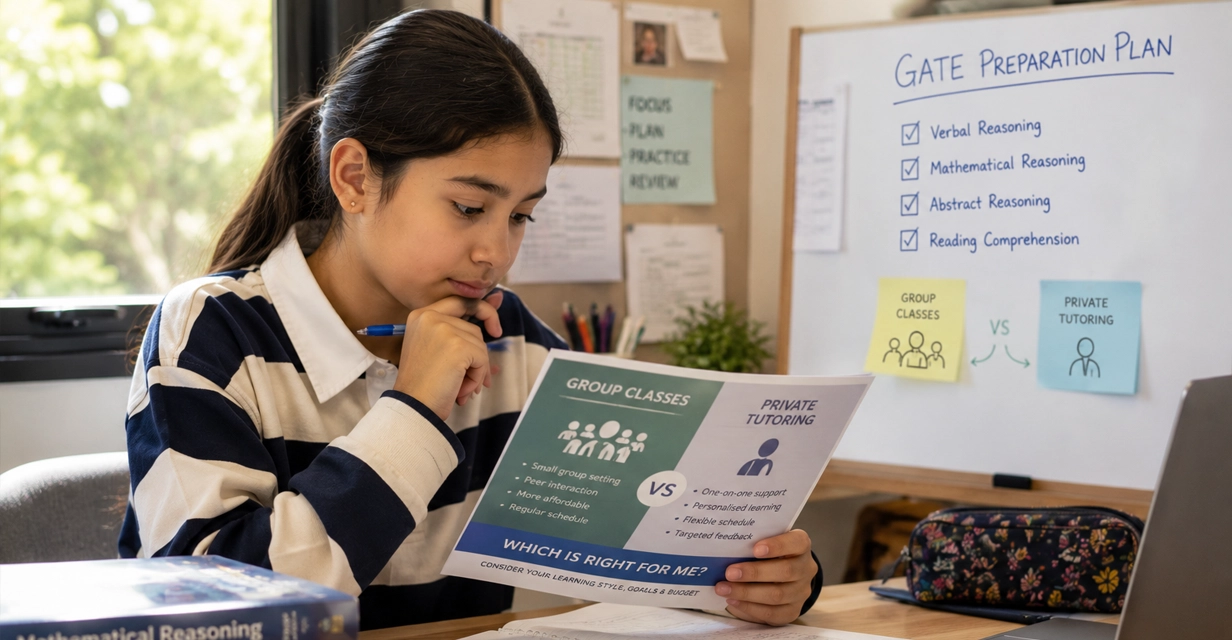
For many families, the best way to prepare for GATE is not to choose between the two formats at all, but to blend them, using small group classes for the core preparation and adding targeted private sessions where needed. This combination captures the strengths of both.
The logic is simple once you see it. Small group classes provide steady, affordable preparation across all four sections, along with the peer motivation and exam style atmosphere that help a child build confidence and pace. They form an excellent backbone for a long preparation period.
Private sessions then plug the specific gaps. If group work reveals that a child is strong everywhere except abstract reasoning, a few one on one sessions can target that weakness intensively, in exactly the way a group cannot. The individual time is spent where it adds the most value, rather than on material the child already handles well.
This blend also reflects the evidence. Since one on one and small group tuition are both highly effective, and the difference between them is modest, combining them lets a family enjoy the motivation and cost of groups while still accessing the precision of individual attention for the areas that need it. It is a practical best of both worlds. For families also wondering whether to attempt home preparation alongside classes, our guide to how to prepare for GATE at home explains how home and class-based preparation can work side by side.
It need not be elaborate. For many children, a regular small group class with the occasional private session before the test is more than enough, and a tutoring centre that offers both formats can help shape the right mix. The goal is simply to give your child broad, consistent preparation, with focused support exactly where it counts. Understanding the ASET exam format in detail can help you plan exactly where that focused support is needed most.
Finding GATE Tutoring Near You in Perth
When searching for GATE tutoring near you in Perth, look beyond the format alone to the quality of the teaching, the size of any groups, and how convenient the sessions will be to sustain. A good fit close to home is easier to keep up over the long preparation period.
Start with the essentials of quality. Whatever the format, check that tutors understand the ASET specifically and the four sections it tests, that they hold a current Working With Children Check, and that they can explain how they will track your child’s progress. These matter far more than whether the setting is private or group. Our guide on how to choose a tutor in Perth covers these essentials in more depth.
Check the group size carefully if you are considering classes. Because effectiveness drops once a group grows beyond about six or seven, ask exactly how many children are in each class. A genuine small group of a few students delivers the benefits described earlier, while a large class begins to resemble ordinary school. You can read more about what the research says on group size in our blog on how small group tutoring works.
Weigh location and consistency together. For families across the southern suburbs, including Canning Vale, Harrisdale, Piara Waters, Hammond Park and Kwinana, a nearby option makes it far easier to attend regularly over many months, and consistency is one of the biggest drivers of results. A shorter trip protects the routine.
Finally, ask whether both formats are available. A centre that offers small group classes and private sessions gives you the flexibility to start with one and add the other if your child’s needs change, which is exactly the kind of adaptable preparation that suits a long GATE journey. It is also worth comparing the top GATE schools in WA so your preparation plan lines up with your child’s actual goal. If you have questions before deciding, our FAQs page and contact page are both good starting points.
Ready to get started?
Experience a full week of
GATE WA tutoring at no cost.
Conclusion
Choosing between group classes and private tutoring for GATE is not a choice between right and wrong, because the evidence shows both are highly effective and the gap between them is small. One on one tutoring offers unmatched personalisation, while small group classes add motivation, peer learning and a taste of the real exam, all at a lower cost.
The decision comes down to your child. A confident, sociable learner who needs broad preparation often thrives in a small group, while a child with a specific weakness or a need for calm, individual attention may do better one on one. For many families, the smartest answer is a blend, using group classes for the core work and private sessions to target the areas that need extra focus.
Whatever you choose, the fundamentals matter most: skilled tutors who know the ASET, genuinely small groups, and a routine your family can sustain. Match the format to your child, keep the preparation consistent, and your child can approach the GATE test confident, well rounded and ready, in the setting that suits them best. For families starting this process with younger children, when to start tutoring in primary school helps you think through the right timing. And for a full picture of the schools your preparation could lead to, our guide to the best GATE schools in WA is a natural companion read.
Get in touch today for a free consultation to find the right GATE tutoring format for your child. Visit Champion Tutors to learn how we help Perth families prepare for GATE every year.
Helpful Links for Parents
Gifted and Talented Secondary Selective Entrance programs, application and testing information, WA Department of Education
https://www.education.wa.edu.au/giftedandtalented
Australian Council for Educational Research (ACER), the body that develops and administers the ASET
https://www.acer.org
Teaching and Learning Toolkit, evidence on one to one and small group tuition, Education Endowment Foundation
https://educationendowmentfoundation.org.uk/education-evidence/teaching-learning-toolkit
Resources Used
Education Endowment Foundation, Teaching and Learning Toolkit, evidence on one to one tuition and small group tuition, including average months of progress and the effect of group size.
WA Department of Education, Gifted and Talented Secondary Selective Entrance programs and the ASET.
Australian Council for Educational Research (ACER), ASET structure and the four assessed sections.